
Medicare Hospice Eligibility in Springfield: Get Expert Guidance

Table of Contents
- Navigating Medicare Hospice Eligibility in Ohio and Indiana
- Specific Requirements for Medicare Hospice Coverage
- Understanding Medicare Coverage for Room and Board in Hospice
- Living Beyond the Six-Month Prognosis: What Happens Next
- Is the Bridge Program Covered by Insurance?
- How to Begin the Eligibility Assessment with Cherish Hospice
- Your Partner in Hospice Care: Cherish Hospice
Navigating Medicare Hospice Eligibility in Ohio and Indiana
Now that you understand the basics of hospice, let’s navigate Medicare hospice eligibility in Ohio and Indiana. Understanding medicare hospice eligibility starts with two key requirements from Medicare.
- A physician and the hospice medical director must certify that the patient is terminally ill, generally with a life expectancy of six months or less if the disease runs its normal course.
- The patient must elect hospice care, choosing comfort-focused support instead of curative treatments.
According to Medicare.gov, these are the basic requirements. Medicare Part A covers hospice benefits; see official medicare coverage information for details. The eligibility rules are the same in Ohio and Indiana, and recertification occurs at 90-day and 60-day intervals.
Please consult with a healthcare professional for personalized medical advice. At Cherish Hospice, care always matters — we’re here to help. Once you meet these criteria, the application process is next.
Specific Requirements for Medicare Hospice Coverage
Understanding medicare hospice eligibility is the first step toward accessing comfort-focused care when facing a terminal illness. Medicare has established clear requirements to ensure that hospice benefits serve those who need them most, providing comprehensive support for patients and their families during this sensitive time.
Eligibility Certification
To qualify for Medicare hospice coverage, a patient must be certified as having a terminal illness with a life expectancy of six months or less if the disease follows its normal course. According to the Centers for Medicare & Medicaid Services (Medicare.gov), this certification must come from both the patient’s attending physician and the hospice medical director. At Cherish Hospice, our Medical Director works closely with referring physicians to ensure all certification criteria are met accurately and compassionately, guiding families through the process without unnecessary stress.
Election and Waiver
When a patient elects Medicare hospice benefits, they make an important choice: they waive Medicare Part A coverage for curative treatments related to their terminal illness. This means shifting focus from aggressive interventions to comfort and quality of life. We help families understand that this election does not mean giving up—it means embracing a different kind of care that prioritizes dignity, symptom management, and emotional well-being.
Levels of Care
Medicare covers four distinct levels of hospice care, each designed to address different patient needs:
- Routine home care: The most common level, delivered wherever the patient calls home, with scheduled visits from the hospice team.
- Continuous home care: Short-term intensive nursing support provided during periods of crisis to manage acute symptoms at home.
- Inpatient respite care: Brief stays in a Medicare-approved facility to give family caregivers a temporary rest, typically up to five days.
- General inpatient care: Care provided in a hospital or skilled nursing facility when symptoms cannot be managed at home.
Each level is designed to respond to the changing needs of patients and their loved ones throughout the hospice journey.
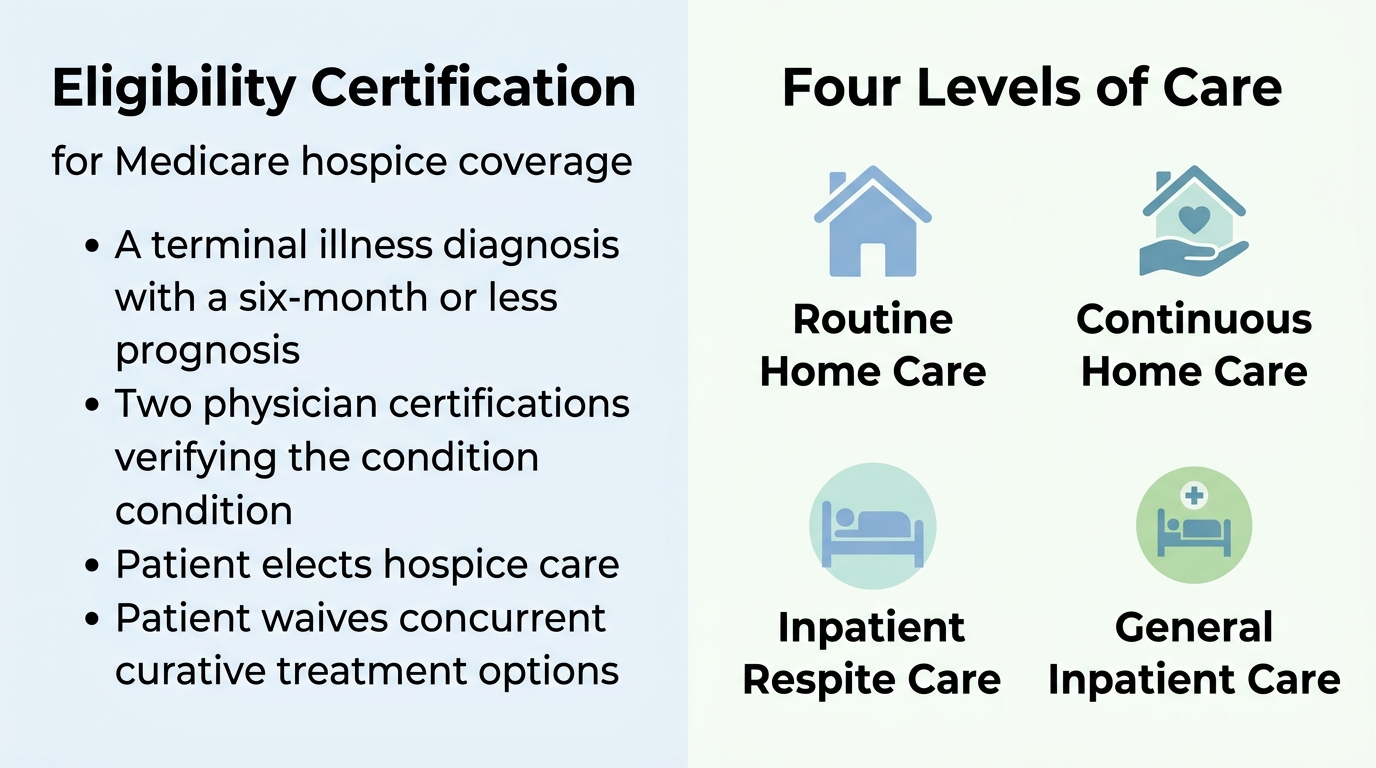
Medicare hospice coverage: eligibility certification and four levels of care
Recertification
Medicare requires recertification of hospice eligibility at regular intervals. After the initial 90-day certification period, a patient must be recertified for a second 90-day period, and then every 60 days thereafter. Each recertification requires the hospice medical director to confirm that the patient continues to meet the six-month prognosis criteria based on the terminal illness’s progression.
Cherish Hospice offers hospice comprehensive care services that meet all Medicare requirements, including expert pain management, skilled nursing care, daily living assistance, and 24/7 support from our dedicated response team. We treat your family like our own, ensuring comfort and dignity through every stage. Please consult with a healthcare professional for personalized medical advice regarding eligibility.
Understanding Medicare Coverage for Room and Board in Hospice
When exploring medicare hospice eligibility, families often ask a crucial question: does Medicare cover room and board during hospice care? The answer depends largely on where you call home. Understanding Medicare coverage for room and board can make a meaningful difference in planning for end-of-life care without unexpected financial burdens. Our team is here to help you navigate these nuances with clarity and compassion.
Medicare Part A covers most hospice services — including skilled nursing, hospice aide support, medical equipment, and medications related to the terminal diagnosis — but it typically does not cover room and board for patients who choose to remain in their own homes. That means if you receive hospice care in your private residence, the cost of your housing, utilities, and meals remains your responsibility. This distinction often surprises families, yet it helps explain why so many people explore additional resources to supplement what the Medicare hospice benefit provides. We cannot change the outcome, but we can affect the journey by guiding you through coverage details and connecting you with options that fit your situation.
For families researching hospice and end of life care in Springfield, Ohio, knowing the Medicare coverage details for room and board is essential. When a patient resides in a Medicare-certified nursing home that serves as their primary residence, Medicare may cover room and board in addition to hospice services if the patient meets eligibility requirements for the hospice benefit. However, in assisted living facilities, the picture changes: Medicare typically pays for the same hospice services — nursing visits, aides, equipment — but does not cover the facility’s room and board charges. Those costs remain the patient’s responsibility unless other payers, such as Medicaid or long-term care insurance, step in. Our hospice team works closely with facilities across Clark County and beyond to help families understand which expenses are covered and where additional support may be available.
Cherish Hospice’s guidance on care settings reinforces this separation between covered services and uncovered living expenses. We often explain to families that care always matters, and part of that commitment means coordinating with nursing homes and assisted living communities to maximize every benefit you have earned. Whether you are receiving comfort care at home or in a facility, eligibility for Medicare hospice coverage includes a full range of clinical and emotional supports: pain management, spiritual care, bereavement counseling, and 24/7 access to our dedicated response team. We treat your family like our own, so you never have to decipher complex coverage rules alone.
Now that you understand room and board coverage, let’s explore the comprehensive services Cherish Hospice provides under the Medicare hospice benefit — and how we tailor those services to your unique needs.
Living Beyond the Six-Month Prognosis: What Happens Next
If you or your loved one lives beyond that initial six months, you may wonder what happens next. The good news is that hospice care can continue as long as it remains appropriate. Many patients live longer than their original prognosis, and Medicare hospice eligibility does not expire after six months. We at Cherish Hospice want you to understand that this is a normal part of the journey.
The Medicare recertification process is designed to ensure that patients continue to receive the care they need. At the start of each benefit period, a hospice physician and the medical director must recertify that the patient remains terminally ill with a life expectancy of six months or less if the disease follows its normal course. This recertification can happen multiple times—there is no hard cap on how long hospice coverage can last. As long as the patient still meets the eligibility criteria, Medicare coverage for hospice can continue indefinitely through successive benefit periods. The key takeaway is that continued hospice eligibility does not require a new application; it simply requires the clinical judgment of the hospice medical team to confirm the ongoing need for care.
Throughout this extended journey, Cherish Hospice continues to deliver our full range of compassionate services. Our skilled nursing team provides expert pain and symptom management, while our hospice aides offer daily living assistance with dignity and respect. Our 24/7 dedicated response team remains available around the clock to answer questions and provide hands-on support whenever your family needs us. Emotional and spiritual support continues as a cornerstone of our care philosophy, because we believe in treating your family like our own. Importantly, bereavement and grief counseling for families in Dayton and surrounding communities is not only available after a loss—it is an integral part of the support we offer from the very beginning of our relationship with you, as detailed in our grief support resources. We are with you for the entire journey.
With this understanding of recertification, we hope you feel reassured that the focus of hospice care shifts from the length of the prognosis to the quality of every remaining moment. At Cherish Hospice, care always matters, and our commitment to your comfort and dignity never wavers. Patients may discontinue hospice services at any time; hospice care focuses on comfort rather than cure.
Is the Bridge Program Covered by Insurance?
A common and natural question families ask is whether Cherish Hospice’s Bridge Program is covered by insurance. The program exists precisely for individuals who do not yet meet medicare hospice eligibility requirements, so the traditional Medicare hospice benefit does not apply. However, this does not mean patients are without options. In fact, the Bridge Program is designed as a proactive layer of support, and we are here to help you navigate what can feel like a complex insurance landscape to find a path forward.
Because the Bridge Program serves those who fall outside of standard hospice coverage rules, its funding model differs from the traditional Medicare benefit. We work closely with patients and families to review a wide range of potential coverage sources. While the Medicare hospice qualification criteria might not be met, coverage for our supportive services may be available through private insurance plans or Medicare Advantage policies that offer supplemental, non-hospice benefits. We also look into state-specific Medicaid programs for eligible individuals. Our team has experience in identifying these pathways, and we are ready to do the investigative work on your behalf. We treat your family like our own, which means we are dedicated to helping you understand your coverage clearly, including any potential out-of-pocket costs.
As part of this commitment, our team will verify your specific benefits. The Bridge Program may be covered as an out-of-network service under some private insurance policies, and we will provide a detailed explanation of any patient cost-sharing responsibilities before services begin. We believe in transparency, so there are no surprises. Importantly, having insurance is not a requirement to access the Bridge Program. If you are uninsured or underinsured, we can discuss alternative payment arrangements directly with our admissions team. Financial considerations should never be the sole barrier to receiving guidance, care, and education during this time.
To get a definitive answer about your specific coverage, the most effective step is to contact our dedicated 24/7 response team. They are available at any hour to answer your questions and can initiate the benefit verification process immediately. Once we verify your coverage, we can guide you through the simple enrollment process. We invite you to reach out for a personalized benefits check, because care always matters, and we are here to help you explore all your options.
How to Begin the Eligibility Assessment with Cherish Hospice
Once you understand the basic eligibility criteria, here is how to begin the assessment with Cherish Hospice. Starting the eligibility assessment often begins with understanding medicare hospice eligibility requirements. Our team is here to guide you through each step with compassion and clarity, because care always matters from the very first conversation.
Step 1: Reach Out to Our Team
The first specific step is to contact Cherish Hospice directly. You can reach us by phone at (877) 234-7474 or through the contact form on our website. When you call, a caring member of our team will listen to your situation and answer your initial questions. We treat your family like our own, so you can expect a warm, pressure-free conversation.
Step 2: Physician Referral and Coordination
A referral from a physician is typically required to begin the formal assessment. If you do not have a referral yet, we can help coordinate with the patient’s doctor to obtain one. This step ensures that your loved one’s medical history is reviewed against medicare hospice eligibility criteria. The process requires certification from two physicians confirming that the patient meets Medicare’s hospice criteria.
Step 3: Review of Medical Records and Scheduling a Visit
The assessment continues with a review of medical records and a discussion of the patient’s condition. Once the initial information is gathered, Cherish Hospice will schedule a visit with a hospice nurse or social worker. During this visit, we will explain our services in detail and answer all your questions. We encourage family members to participate in this meeting, as your insights and concerns are invaluable.
Step 4: Access Additional Support and Resources
From the very start, you can access our supportive resources. We encourage families to prepare by reviewing our End-of-Life Care Conversation FAQ if you want to start family discussions before or during the assessment. Our team can also connect you with our hospice volunteer programs, which provide companionship and help with meaningful activities like creating memory books.
After your eligibility assessment is complete, our care team will work with you to develop a personalized care plan that honors your loved one’s wishes. Reach out to us today to start the conversation; we are here to walk with you through every part of this journey. Please remember that patients may discontinue hospice services at any time; hospice care focuses on comfort rather than cure.
Your Partner in Hospice Care: Cherish Hospice
If you are exploring Medicare hospice eligibility for your loved one, know that you do not have to navigate this alone. At Cherish Hospice, we believe that care always matters, and we treat your family like our own. Our compassionate 24/7 dedicated response team provides immediate hands-on support, ensuring individualized pain and symptom management and access to alternative therapies that prioritize comfort and dignity. We cannot change the outcome, but we can affect the journey.
As we explain in our FAQ, we offer spiritual and bereavement support for families in Springfield. Our FAQ on grief support in Dayton confirms that we provide this crucial care to families there. For patients not yet qualifying for hospice, our Bridge Program offers education and guidance. Reach out today for a conversation about how we can support your family.