

Table of Contents
- Hospice Care for Parkinson's Patients
- When Is It Time for Hospice Care in Advanced Parkinson's Disease?
- Hospice Eligibility for Parkinson's Disease
- Advanced Parkinson's Symptoms That Indicate a Patient May Be Ready for Hospice
- Managing Swallowing Difficulties, Rigidity, and Other Advanced Parkinson's Challenges
- Medications, Care Plans, and Ongoing Support in Hospice
- Compassionate Hospice Care for Parkinson's Patients with Cherish Hospice
Hospice Care for Parkinson’s Patients
Hospice care for Parkinson’s patients focuses on comfort and dignity by managing symptoms and supporting quality of life when curative treatments no longer align with the patient’s goals. Our team serves families across Ohio and Indiana, providing compassionate care wherever loved ones call home, whether in a private residence, hospital, or long-term care facility.
We center care on the whole person, addressing physical discomfort, emotional strain, and spiritual needs through a dedicated response team available around the clock. This support does not end with death and includes counselling given to grieving families that enables those who have lost a loved one to work through their grief. An interdisciplinary team—including doctors, nurses, social workers, chaplains, and trained volunteers—works together to honor each patient’s preferences and ensure their comfort always matters.
Key Takeaways
- Families often ask us when to consider hospice care for Parkinson’s patients as the disease advances.
- In order to qualify for hospice care when dealing with Parkinson’s illness, a physician must certify a terminal prognosis.
- When Parkinson’s progresses, families sometimes ask themselves what signals indicate hospice care is appropriate for a family member.
- While in the later phases of Parkinson’s Disease, hospice care for Parkinson’s patients addresses comfort, safety, dignity as well as helping families in Ohio & Indiana deal with daily symptoms.
- Even if your loved one has advanced Parkinson’s disease, when he enters hospice his medical treatments will not end.
When Is It Time for Hospice Care in Advanced Parkinson’s Disease?
Families often ask us when to consider hospice care for Parkinson’s patients as the disease advances. This transition isn’t about giving up; it’s about shifting focus to comfort, dignity, and quality of life when curative treatments no longer align with the patient’s goals. We cannot change the outcome, but we can ensure every moment is filled with compassion and support tailored to their needs.
When curative treatments give way to comfort-focused care, families notice a shift in priorities. Our interdisciplinary team—including doctors, nurses, and chaplains—manages pain and other distressing symptoms under the guidance of our medical director, providing 24/7 nursing support. Medications for pain, secretions, nausea, and anxiety are carefully adjusted to bring relief, while practical comfort measures like repositioning every two hours help prevent skin breakdown and ease physical discomfort. Alternative therapies such as gentle massage, music-based care, pet therapy, and aromatherapy further nurture both the patient and their family.
Emotional support becomes just as vital as medical care during this time. We encourage families to practice active listening, offering silent presence and allowing their loved one to share memories or simply sit together without pressure. Reminiscing about joyful moments, creating memory books, or recording personal messages can bring comfort and connection. Our dedicated spiritual teams and volunteers assist with legacy activities, ensuring families feel supported throughout the entirety of the hospice journey.
Our support doesn’t end when a patient passes. Cherish Hospice provides bereavement and grief counseling for families for at least one year after loss, ensuring no one walks this journey alone. If you’re noticing increasing dependence in daily living, worsening swallowing or communication difficulties, or rising caregiver strain, we’re here to help you explore whether hospice care for Parkinson’s patients in the later stages could bring the comfort and peace your loved one deserves.
Hospice Eligibility for Parkinson’s Disease
In order to qualify for hospice care when dealing with Parkinson’s illness, a physician must certify a terminal prognosis. To do this with Parkinson’s disease, this medical professional will have to assess clinical decline, look for specific functional markers, and determine that the patient is expected to live six months or less if the disease runs its typical course.
Our team works closely with patients’ physicians to assess readiness for hospice, ensuring the process respects both medical realities and the patient’s wishes. Families play an important role in this process by sharing observations about symptom progression and daily challenges, which helps guide the physician’s evaluation. These insights are especially valuable when evaluating how advanced the disease has become, as they provide a clearer picture of the patient’s current condition and needs. When families notice increased difficulty with mobility, worsening cognitive changes, or escalating care needs, those details help physicians determine whether the clinical decline aligns with hospice eligibility criteria.
Once a patient qualifies, Ohio-licensed hospice programs provide protections and services families can rely on. Under Ohio Administrative Code Rule 3701-19-07, licensed programs cannot deny or discontinue care based on a patient’s financial status or ability to pay. Care is available around the clock through our dedicated response teams, and physician medical direction ensures continuous oversight. Bereavement counseling for families is not optional, it’s a required part of licensed hospice care in Ohio, designed to support loved ones through their grief journey. These services are provided by interdisciplinary teams that include nurses, social workers, and spiritual care providers, all working together to meet each family’s unique needs.
If you’re wondering whether your loved one may qualify, we’re here to help. Eligibility ultimately rests on a physician’s assessment of how advanced the disease has become, but we can affect the journey by providing compassionate, patient-centered care tailored to each family’s needs.
Advanced Parkinson’s Symptoms That Indicate a Patient May Be Ready for Hospice
When Parkinson’s progresses, families sometimes ask themselves what signals indicate hospice care is appropriate for a family member. Recognizing the right moment isn’t about giving up, it’s about ensuring comfort and dignity as the disease advances. We provide assistance in determining what those “practical” indicators look like and help decide what happens next to ensure a family member in OHIO and INDIANA can be as comfortable as possible as the disease progresses.
It is well recognized that a decline in swallowing ability, known as dysphagia, is one of the most telling indicators. As neurological decline and muscle wasting progress, safe swallowing becomes increasingly difficult. It should not be thought that this is only due to lack of appetite. When food, liquid, or even saliva enters the lungs, it’s called aspiration, which can lead to pneumonia, malnutrition, or dehydration. How much aspiration occurs determines its seriousness along with the strength of a patient’s natural defenses against the effects of aspiration. There is little evidence for effective interventions, and patients’ attention to the problem tends to diminish as the disease progresses, emphasizing the need for professional involvement.
There is also physical decline. People become thinner, muscles waste away, and people become more dependent upon their caregivers for doing such things as dressing or taking a bath. They don’t necessarily just get weaker, but rather the body cannot maintain what has been lost. This is something families tend to recognize first, and therefore, another trigger for considering further interventions.
Hospice care intervenes at this point to attend primarily to comfort. Our Medical Director along with our 24/7 nursing team manages pain medication, secretions, nausea, anxiety and positions the patient on schedule to avoid pressure ulcers. They may provide gentle massage, pet therapy, etc. This is when we shift the focus from curing to caring, allowing patients to get through their days as comfortably as possible.
Managing Swallowing Difficulties, Rigidity, and Other Advanced Parkinson’s Challenges
While in the later phases of Parkinson’s Disease, hospice care for Parkinson’s patients addresses comfort, safety, dignity as well as helping families in Ohio & Indiana deal with daily symptoms.
Swallowing problems, called dysphagia, are both common and distressing in advanced neurological illness. Involuntary weakening or lack of co-ordination of the muscles that enable us to swallow normally means there is increased danger of food, liquid, or saliva being breathed into our lungs, causing various complications including pneumonia, malnutrition, dehydration, or even airways obstruction. The effect of this depends upon how much material gets aspirated (inhaled), and on the strength of the body’s own defence mechanisms against it. These tend to be weak when patients become severely muscle wasted, or have general frailty.
We meet our patients’ challenges using gentle, loving care. Every two hours we assist in positioning for rigidness to ease as well as to reduce the threat of decubitus ulceration. Anti-secretory agents can be prescribed to treat an overabundance of secretions. Our Medical Director along with Nursing may adjust medications such as anticholinergics, antiemetics, and anxiolytics when needed to aid our patients with comfort and tranquility. These modifications are made carefully to align with each patient’s goals of care and overall condition.
This is a core function for our hospice staff. Hospice aids provide bath, dressing, groom and assist in mobility if rigidity and/or weakness has made this task too hard. This helps families, who tell us it is invaluable, allowing them to focus on connection and presence rather than physical strain. We utilize alternative therapies including Cherish Touch as well as pet therapy to help reduce anxiety, stress and offer calmness on some of the hardest days.
Managing advanced symptoms calls for a coordinated team and an individualized care plan. With a dedicated 24/7 response team, we are always available to address urgent needs, ensuring families never feel alone as they navigate this stage of Parkinson’s.
Medications, Care Plans, and Ongoing Support in Hospice
Even if your loved one has advanced Parkinson’s disease, when he enters hospice his medical treatments will not end. Medications will still be prescribed for symptom management because we want to provide as much comfort to him as possible. Our team of doctors, nurses, social workers, chaplains, and volunteer caregivers work together to tailor treatment plans in response to any new symptoms they may develop while in hospice care.
We provide 24 hour-a-day / 7 day-a-week hands-on support through our dedicated response team, available whenever medical needs arise, whether at their home, in hospital, or in a nursing home. The clients’ daily living activities, including bathing, dressing, grooming and mobility support, are seamlessly woven into each care plan to ensure dignity and comfort every day. We provide complementary therapies including aroma-therapy, music based support, massage via our Cherish Touch programme as well as pet therapy, to add a soft side to the more hard lined clinical care.
Emotional, spiritual, and social support remains central throughout the journey, for both the patient and family. Our chaplains and social workers offer guidance and presence, while bereavement counseling extends compassionate support for up to a year after a loss. Importantly, families can pause or stop hospice services at any time without penalty, allowing them to choose what feels right for their loved one. We encourage keeping an updated medication list and reviewing every prescription with our team so the care plan stays accurate and responsive.
Care plans will be revisited regularly as Parkinson’s symptoms evolve, working together with the family to make sure they always reflect the patient’s current needs and wishes. We want to provide our Ohio and Indiana clients steady, patient-centered care along their path.
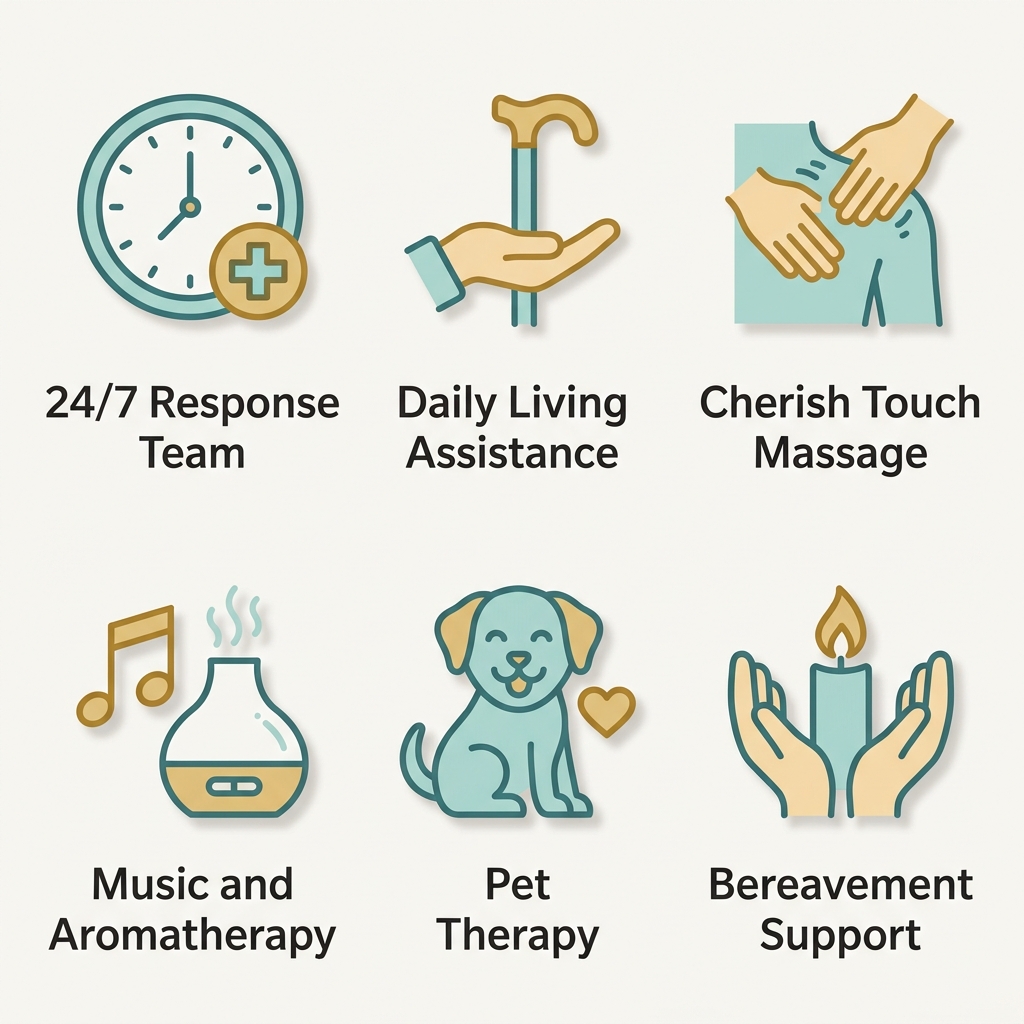
Six pillars of hospice support: round-the-clock care, daily assistance, therapies, and bereavement.
Frequently Asked Questions about Hospice Care for Parkinson’s Disease
When is it time to consider hospice care for a loved one with Parkinson’s disease?
Hospice care becomes appropriate when curative treatments no longer align with the patient’s goals and comfort, dignity, and quality of life take priority. Families often notice increasing dependence in daily living, worsening swallowing or communication difficulties, or rising caregiver strain as signs it may be time.
Does a diagnosis of Parkinson’s disease automatically qualify a patient for hospice care?
No, a Parkinson’s diagnosis alone does not automatically qualify a patient for hospice. A physician must certify a terminal prognosis, typically a six-month or less life expectancy if the disease follows its usual course.
What specific symptoms of advanced Parkinson’s indicate that a patient may be ready for hospice?
Advanced Parkinson’s symptoms that may indicate hospice readiness include significant swallowing difficulties, aspiration risks such as pneumonia or malnutrition, severe muscle wasting, increased dependence in daily activities, and rising caregiver burden.
How does hospice care help manage the specific challenges of advanced Parkinson’s such as swallowing difficulties and rigidity?
Hospice care manages swallowing difficulties through careful medication adjustments, positioning every two hours to ease rigidity and prevent skin breakdown, and providing alternative therapies like gentle massage or pet therapy to reduce anxiety and foster connection.
Can a patient with Parkinson’s continue to receive their regular medications after starting hospice care?
Yes, patients with Parkinson’s can continue to receive medications after starting hospice care. Hospice focuses on symptom management, so medications for pain, secretions, nausea, and anxiety are carefully adjusted to provide comfort.
Compassionate Hospice Care for Parkinson’s Patients with Cherish Hospice
When a family member is struggling with Parkinson’s disease, Hospice care for patients with Parkinson’s in Ohio and Indiana provides comfort-focused support that honors their dignity and quality of life. Our care team will go where you’re living – Springfield, Canton, Warsaw – so patients receive the right help at the right time.
Our hospice program staffs patients and families with an interdisciplinary team of nurses, aides, social workers, chaplains and volunteers that address physical, emotional and spiritual needs. Our bereavement counseling continues for at least one year following death, and patients may pause or stop their hospice services at any time without penalty.
Give us a call at (937) 355-7154 if you have any questions about the needs of your family or would like more information. This website cannot provide specific medical advice; please refer to a physician for such advice. All patients respond differently.
Talk with Our Hospice Team
Understanding when hospice care for Parkinson’s patients is appropriate can feel overwhelming, but you don’t have to sort through it alone. As you’ve seen throughout this guide, hospice focuses on comfort and dignity, with an interdisciplinary team supporting both your loved one and your family. Cherish Hospice is located at 1929 East High Street, Springfield, OH 45505, and our team is available at (937) 355 – 7154 to answer your questions. We serve families across Ohio and Indiana, whether your loved one lives at home, in a hospital, or in a long-term care facility. A simple conversation with our team can help you understand eligibility and what to expect, without any pressure to decide right away. Reach out today to schedule an assessment or simply ask the questions weighing on your heart. Support for your whole family, including bereavement care, is part of every plan we build.