
Palliative Care vs Hospice: Complete Comparison Guide

Table of Contents
- Palliative Care vs. Hospice: What Families in Ohio and Indiana Should Know
- Key Differences Between Palliative Care and Hospice
- Curative Treatment and the Transition to Hospice Care
- Hospice Eligibility Criteria Under Medicare: A Practical Guide
- Medicare Hospice Benefit: What Services Are Covered and How to Elect
- Common Questions About Palliative Care and Hospice Answered
- Making Informed Care Decisions for Your Loved One
Palliative Care vs. Hospice: What Families in Ohio and Indiana Should Know
When families are facing a serious illness, understanding palliative care vs hospice can feel overwhelming. Both forms of care are designed to bring comfort and improve quality of life, but they differ in when and how they are provided.
According to Hospice.com, the key distinction is that palliative care can be provided alongside curative treatment at any stage of a serious illness, while hospice care begins when curative treatments are no longer sought. Palliative care, which according to the Center to Advance Palliative Care (CAPC) focuses on palliative care definition and benefits, can start at diagnosis and help manage symptoms and stress. Hospice care, on the other hand, is only appropriate after a doctor certifies a terminal illness with a life expectancy of six months or less and the patient ceases curative treatments. To receive hospice, patients must meet specific hospice eligibility criteria. The Medicare hospice benefit and most insurance plans cover the full range of hospice services, helping families focus on comfort and quality time. It’s important to know that hospice care focuses on comfort rather than cure, and patients may discontinue hospice services at any time if they choose.
We at Cherish Hospice believe care always matters, and we offer both hospice and palliative care across dozens of communities in Ohio and Indiana, including our locations in Springfield and Canton, Ohio, and Warsaw, Indiana, as well as all surrounding counties. Whether you are seeking palliative support early in a diagnosis or hospice care when the time is right, our compassionate team is here to listen, answer your questions, and help guide you toward the right care for your loved one’s needs. Reach out to us anytime to learn more.
Key Differences Between Palliative Care and Hospice
Many families researching palliative care vs hospice feel uncertain about which is right for their loved one’s needs. We know these decisions can feel overwhelming, so we want to offer clear, compassionate guidance. For a detailed hospice and palliative care comparison, the table below highlights how the two types of support differ across critical areas.
The following table summarizes the key differences in a side-by-side view, drawing on authoritative information from Hospice.com and the Center to Advance Palliative Care.
Eligibility is often the first point of distinction. Palliative care can begin at diagnosis and continue through treatment, offering relief regardless of the stage. In contrast, hospice eligibility criteria require a doctor’s certification that the illness is terminal and that life expectancy is six months or less if the disease follows its usual course. This timing is key: hospice becomes appropriate when curative efforts no longer align with the patient’s goals.
Another important difference is the role of curative treatment. Palliative care is designed to walk alongside active medical interventions, managing pain, stress, and side effects so patients can tolerate therapies. Hospice care shifts the focus entirely to comfort and dignity, addressing physical, emotional, and spiritual needs without treatments meant to cure the underlying illness. The choice depends on the patient’s values and medical status, and we believe both paths honor the individual’s wishes.
Coverage and duration also vary significantly. Palliative care services are typically billed through Medicare Part B or private insurance, often with some cost-sharing. Hospice care, however, is covered by the medicare hospice benefit under Part A, which generally includes little to no out-of-pocket expense for eligible patients. While palliative care can continue indefinitely, hospice follows a structure of benefit periods that require ongoing recertification, ensuring that care remains appropriate as needs evolve.
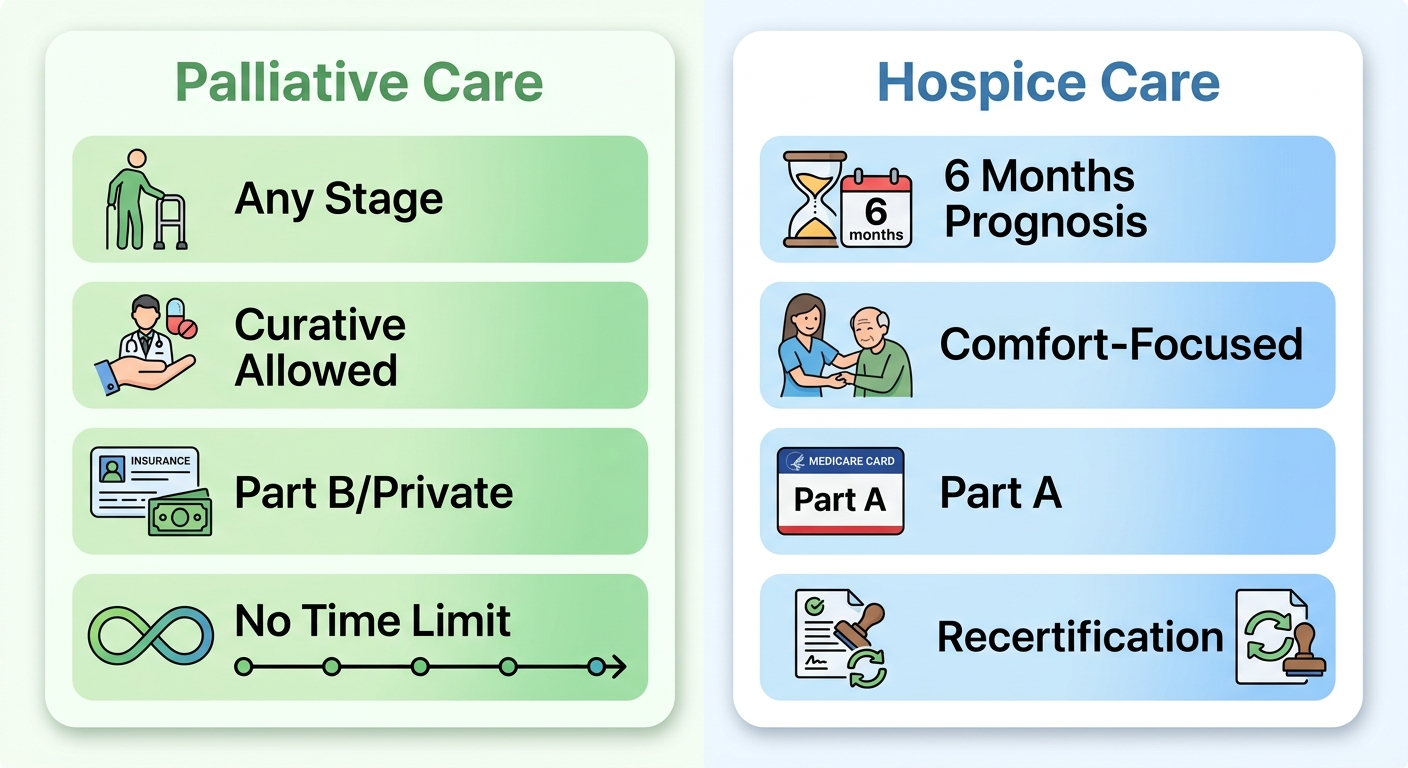
Key differences between palliative and hospice care in a clean infographic.
A visual summary can help reinforce these distinctions, but the heart of the matter is always the person receiving care. Both palliative and hospice approaches prioritize quality of life and respect for dignity, simply at different points along the illness journey. Remember, at Cherish Hospice, we believe care always matters, and we treat your family like our own.
Curative Treatment and the Transition to Hospice Care
Understanding palliative care vs hospice helps families make informed decisions. Palliative care can be provided alongside curative treatment, while hospice focuses solely on comfort when a cure is no longer possible. This section explores how these paths work and when a transition becomes necessary.
Curative Treatment in Palliative Care
Palliative care is designed to provide end of life comfort measures — such as pain relief, symptom management, and emotional support — while patients continue to receive curative treatments. At Cherish Hospice, we believe care always matters, so our palliative team works with your regular doctors to coordinate care without interrupting therapies like chemotherapy or dialysis. This integrated model means you never have to choose between managing symptoms and pursuing a cure. Palliative care can be provided in any setting and has no time limit; you can benefit from symptom support for as long as it is needed. Throughout this journey, we hold that we cannot change the outcome, but we can affect the journey, and our palliative services reflect that commitment.
Transitioning to Hospice When Curative Treatment Ends
When curative treatments are no longer effective, many families consider the shift from palliative care to hospice. Understanding palliative care vs hospice during this transition helps you know what to expect. To qualify for hospice, a physician must certify a terminal illness with a life expectancy of six months or less—this is the core of hospice eligibility criteria. At this point, the focus moves entirely to comfort and quality of life, and curative treatments are stopped. However, you can revoke hospice at any time to resume curative treatment. A simple written revocation, as noted by Inspire Hospice, restores Medicare coverage for curative care. At Cherish Hospice, we treat your family like our own, guiding you through this transition. For patients who don’t yet meet hospice eligibility but need extra support, our Bridge Program offers symptom monitoring, advance care planning, and nursing guidance until a hospice admission is appropriate. Patients may discontinue hospice services at any time; hospice care focuses on comfort rather than cure.
Medicare Coverage Differences Between Palliative Care and Hospice
Medicare covers palliative care and hospice differently. Palliative care is typically covered under Medicare Part B, which includes doctor visits and symptom management services. You pay 20% coinsurance after the Part B deductible, with no time limit. In contrast, the Medicare hospice benefit (Part A) provides comprehensive hospice coverage with minimal copays: most services are covered at 100%, with only small copays for respite care ($5/day) and outpatient drugs ($5/prescription). The hospice benefit includes two initial 90-day periods, followed by unlimited 60-day periods with recertification, plus 24/7 on-call support and short-term inpatient care for crises. According to Medicare.gov, patients must forgo curative treatment to enroll, whereas Part B allows curative services alongside palliative care. The table below summarizes key differences.
Results may vary based on individual patient conditions. Please consult with a healthcare professional for personalized medical advice. Understanding these coverage differences helps you plan ahead. Next, we’ll look at how our team supports both paths.
Hospice Eligibility Criteria Under Medicare: A Practical Guide
Once you understand hospice, the next question is: Who qualifies? If you are weighing palliative care vs hospice, understanding Medicare eligibility is critical. At Cherish Hospice, we believe that care always matters, and our Medicare hospice coverage guide can help, in line with CMS requirements.
The following quick reference summarizes the key criteria:
| Aspect | Palliative Care | Hospice Care |
|---|---|---|
| Eligibility Stage | Any stage of serious illness, from diagnosis onward | Terminal illness with prognosis of 6 months or less if disease runs its natural course |
| Curative Treatment | Yes, can be provided alongside curative treatments | No, focus is on comfort care; curative treatments generally not covered |
| Goal | Improve quality of life and manage symptoms while treating the illness | Provide comfort and dignity when cure is no longer the focus |
| Coverage | Medicare Part B or private insurance; may include cost-sharing | Medicare Hospice Benefit (Part A); minimal out-of-pocket costs |
| Duration | No time limit; can continue as long as needed | Two 90-day periods, then unlimited 60-day periods with recertification |
| Team Composition | May include primary doctor, specialists, nurses, social workers | Interdisciplinary team: physicians, nurses, aides, chaplains, social workers, volunteers |
Sources: https://www.medicare.gov/coverage/hospice-care and https://www.crossroadshospice.com/hospice-palliative-care-resources/hospice-eligibility/dementia-hospice-eligibility/
Medicare Requirements for Hospice
The Medicare hospice eligibility criteria start with a terminal prognosis of six months or less. Two physicians must certify this: the patient’s own doctor and the hospice medical director. We often help families understand that the patient or their legal representative must sign an election statement choosing the Medicare hospice benefit over curative treatment. This shifts focus to comfort. Most hospice services take place in the patient’s home, a nursing home, or assisted living; inpatient hospice is only for short-term symptom management or respite. The benefit periods consist of two 90-day segments, then unlimited 60-day periods, each requiring recertification of terminal status. Patients can revoke the hospice election at any time, resume standard Medicare Part A coverage without penalty, and change providers once per benefit period; the election statement lists non-covered items.
Determining the Six-Month Prognosis
When evaluating patients for the Medicare hospice benefit, physicians rely on clinical guidelines, functional decline, and disease-specific criteria. Two certifying doctors assess whether the terminal illness would likely cause death within six months if it follows its natural progression. They review the patient’s recent health trajectory, weight loss, infections, and overall functional status. The Karnofsky Performance Scale, which rates a patient’s ability to perform daily activities, is a common tool. For cancer patients, rapid deterioration or metastasis may indicate eligibility; for advanced heart disease, repeated hospitalizations and breathlessness at rest are key signals. In COPD, declining lung function and frequent exacerbations guide the prognosis. For dementia, doctors use staging tools like the FAST scale to confirm advanced decline. This multidisciplinary review ensures the certification is based on sound medical evidence, not guesswork.
Dementia and Hospice Eligibility
Dementia patients can qualify for hospice under Medicare when their disease reaches an advanced stage. The Functional Assessment Staging (FAST) scale is widely used to measure decline; stage 7 (inability to speak, walk, or sit up without assistance) often signals a prognosis of six months or less. Other indicators include weight loss, recurrent infections, and dependence for all personal care. Patients who cannot dress, bathe, or communicate meaningfully meet the functional threshold. Physicians also consider the rapidity of decline and the presence of other serious conditions. At Cherish Hospice, we understand that families facing a dementia diagnosis need compassionate, clear information. We help caregivers recognize these signs and connect them with appropriate evaluation. The goal is to ensure that when comfort-focused care is needed, the transition is as truly gentle as possible.
What Happens If the Patient Outlives the Prognosis?
When a hospice patient lives beyond the initial six-month prognosis, coverage does not end. Our medical director can recertify the terminal condition during a face-to-face encounter, allowing the patient to continue receiving the Medicare hospice benefit. The benefit periods are unlimited; after the first two 90-day periods, patients receive consecutive 60-day periods as long as recertification occurs. This flexibility ensures no one is discharged simply because a prognosis was conservative. At Cherish Hospice, we have seen many patients thrive for months longer than expected, and we remain committed to their comfort care.
Patients may discontinue hospice services at any time; hospice care focuses on comfort rather than cure.
Of course, knowing you qualify is only half the story. The next section will guide you through how to enroll in hospice care.
Results may vary based on individual patient conditions. Please consult with a healthcare professional for personalized medical advice.
Medicare Hospice Benefit: What Services Are Covered and How to Elect
Understanding the difference between palliative care vs hospice helps families choose the right benefit. The Medicare hospice benefit provides comfort-focused care for patients with a terminal illness who meet hospice eligibility criteria. It covers end of life comfort measures rather than curative treatments, offering support when curative options are not effective.
The following table outlines the main services covered under the Medicare hospice benefit:
| Aspect | Palliative Care Coverage (Medicare Part B) | Hospice Coverage (Medicare Hospice Benefit) |
|---|---|---|
| Medicare Part | Part B (Medical Insurance) | Part A (Hospice Benefit) |
| Curative Treatment | Covered | Not covered |
| Cost Sharing | 20% coinsurance for Part B services after deductible | Minimal copays for respite care ($5 per day) and outpatient drugs ($5 per prescription); most services covered at 100% |
| Duration | No time limit; can continue indefinitely | Two initial 90-day periods, then unlimited 60-day periods with recertification |
| 24/7 Care | Routine home care; intermittent skilled nursing visits | Routine home care with 24/7 on-call support; continuous care may be covered during short-term crises |
| Inpatient Care | Covered under Part A (hospital) or Part B (outpatient) as needed | Inpatient respite care (up to 5 days) and short-term inpatient symptom management covered |
To elect the benefit, the patient signs an election form that waives curative treatment for the terminal illness and chooses comfort care. A doctor certifies a life expectancy of six months or less and recertifies at each benefit period—two initial 90-day periods, then unlimited 60-day periods. Most services have no deductible or copay, except a copay of up to $5 for outpatient symptom-management drugs. Room and board are not covered at home; patients may revoke the benefit at any time to resume curative care.
Cherish Hospice, a Medicare-approved provider, serves families in Springfield, OH, and across Ohio and Indiana. We treat your family like our own, and care always matters. Our team provides bereavement support and a Bridge Program for those not yet eligible. Contact us for guidance on the Medicare hospice benefit.
Common Questions About Palliative Care and Hospice Answered
Below, we answer the most common questions families ask about these two types of care.
What’s the difference between palliative care and hospice? In comparing palliative care vs hospice, palliative care eases symptoms at any stage, while hospice comforts those with a six-month prognosis and no curative focus.
Who qualifies for hospice care? According to Cherish Hospice, hospice eligibility criteria require a terminal diagnosis and a physician’s certification of six months or less; care always matters regardless of the timeline.
Does Medicare cover hospice? Yes, the Medicare hospice benefit covers all services related to the terminal illness, including nursing, medications, and equipment, with no deductibles.
Are there special hospice benefits for veterans? For veterans, our program explains hospice benefits for veterans while we treat your family like our own.
Results may vary. Please consult with a healthcare professional for personalized medical advice.
Making Informed Care Decisions for Your Loved One
When facing a serious illness, understanding palliative care vs hospice is essential for making informed care decisions for your loved one. Palliative care is available at any stage of a serious illness and alongside curative treatment, while hospice is for terminal prognoses, focusing on comfort. Hospice eligibility criteria require a physician-certified prognosis of six months or less and a choice to forgo curative treatments. The Medicare hospice benefit covers medication, equipment, and interdisciplinary team support.
Please consult a healthcare professional; results vary. We cannot change the outcome, but we can affect the journey, and we treat your family like our own because care always matters.