
Table of Contents
What the VA Does When a Veteran Dies
When a family asks what the VA does when a veteran dies, the answer from the U.S. Department of Veterans Affairs centers on a burial allowance that reimburses out-of-pocket funeral and burial costs. The benefit applies when no other government assistance covered those expenses, and surviving spouses listed in the veteran’s VA profile may receive an automatic payment without needing to file a claim.
If another family member or an executor paid for the burial expenses, simply file VA Form 21P-530EZ alongside the death certificate and receipts. Approval will only be given if no other reimbursement was received.
Burial allowances vary based on the veteran’s date of death, thus it would be crucial for family members to check out the VA’s current schedule. With a clearer idea about the financial benefits available through burial allowance, families will start taking steps to prepare all the required papers.
Key Takeaways
- Filing a pre-need eligibility application and keeping your VA records current are steps that ensure burial benefits are processed smoothly when the time comes.
- In order to file a claim for va survivors’ benefits you will need proof of your loved one’s military service as well as how he/she is related to the deceased veteran.
- After gathering the necessary documents, the next phase involves determining if your deceased loved one qualifies for burial benefits from the the VA.
- The burial allowance helps cover funeral and burial costs, and the amount you receive is determined by the veteran’s date of death, according to the VA; the VA also offers plot and headstone allowances.
- After filing for burial assistance, another question that arises is about VA Benefits and whether they continue following the death of a Veteran.
Essential Preparations for VA Benefits
Filing a pre-need eligibility application and keeping your VA records current are steps that ensure burial benefits are processed smoothly when the time comes. We cannot change the outcome, but we can help lighten the administrative burden at the end of life.
- Confirm that the veteran’s spouse is listed in the VA profile. The U.S. Department of Veterans Affairs advises that a surviving spouse on file may receive automatic burial benefit payments without needing to file a separate claim.
- Apply for a pre-need eligibility determination. According to VA policy, the resulting eligibility letter confirms your benefit but does not require you to use a national cemetery, leaving your family free to choose a final resting place.
- Keep your information up-to-date. The VA encourages you to update your contact details or marital status whenever circumstances change, and to share the pre-need decision letter with your family or funeral director so it is at hand when needed.
To help support Veterans and their loved ones at Cherish Hospice, our veteran program offers assistance during every phase, providing information on how to access VA benefits. With these basics out of the way, your next job should be acquiring the paperwork needed for a full application, things like the veteran’s DD214, his/her discharging document, and also death certificate.
Step 1: Gather Necessary Documents and Information
In order to file a claim for va survivors’ benefits you will need proof of your loved one’s military service as well as how he/she is related to the deceased veteran. At Cherish Hospice we can help the families in Springfield, Ohio gather all required papers needed to get their claim started easily.
- The veteran’s discharge or separation papers (DD214 or equivalent)
- An official copy of the veteran’s death certificate
- The claimant’s marriage certificate (for surviving spouses) or birth certificate (for dependent children or parents)
- The appropriate VA application form, such as VA Form 21P-534EZ for spouses and children or VA Form 21P-535 for surviving parents
- Certified court documents if a legal guardian or estate representative is filing
The Department of Veteran’s Affairs said that any claim made for accrued benefits has to be filed within one year following death of the veteran. The VA said its legal order of precedence is surviving spouse, then dependent children, then dependent parents. The next action will be verification of whether any of those people who may apply can receive burial benefits.
Step 2: Verify Eligibility for Burial Benefits
After gathering the necessary documents, the next phase involves determining if your deceased loved one qualifies for burial benefits from the the VA. Burial allowance can be made available to survivors such as spouse(s), child(ren), parent(s) or representative of the funeral home that paid the bill, provided the veteran was not dishonorably discharged. And only in circumstances where nobody else assumes the cost of the service, will this money go toward payment.
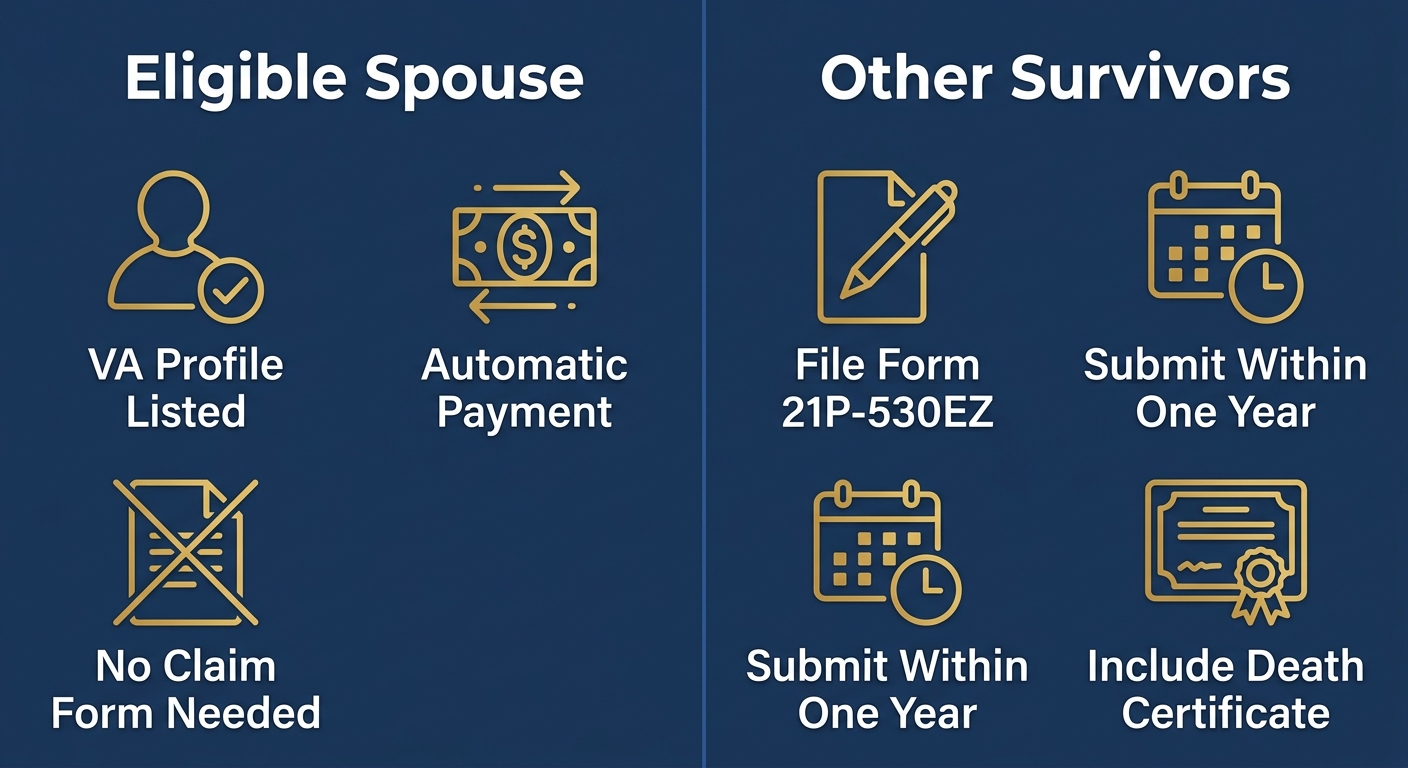
Veterans can apply for a pre-need eligibility determination to verify benefits in advance. The pre-need determination does not compel the family to use a national cemetery; you may still choose a private burial and receive a government headstone or marker. Any surviving spouse noted on the veteran’s VA profile may receive burial payments automatically without a separate claim. Eligibility can be re-evaluated due to changes in law or personal circumstances.
We treat your family like our own.
Step 3: Understand Burial Allowance and Reimbursement Limits
The burial allowance helps cover funeral and burial costs, and the amount you receive is determined by the veteran’s date of death, according to the VA; the VA also offers plot and headstone allowances. For a non-service-connected death on or after September 11, 2001, the basic burial allowance is up to $2,000; for earlier deaths, it’s $1,500. Service-connected deaths qualify for higher allowances, including a separate plot-interment payment. Understanding what the VA covers when a veteran dies helps survivors plan their finances. If you pay funeral expenses out of pocket and receive no other government burial assistance, you may apply for reimbursement, and surviving spouses whose information is already in the VA profile may receive the payment automatically. When applying, you’ll use VA Form 21P-530EZ, and you’ll need the veteran’s death certificate with receipts for the funeral costs you paid. We can help you gather the information needed for submitting your application.
Step 4: File Your Application for VA Burial Benefits
Once we know the amount to be paid, it’s time to apply for funeral benefits on behalf of the deceased. Survivors can submit a claim using VA Form 21P-530EZ, the official Application for Burial Benefits. According to the U.S. Department of Veterans Affairs, the completed form and supporting documents can be mailed to the appropriate VA regional office or submitted through the VA’s online portal if electronic filing is available.
These might include the veteran’s death certificate, receipted ticket for transportation costs, and veteran’s DD214 or some other proof of military service. An important exception applies if a surviving spouse is already listed on the veteran’s VA profile. When this occurs, benefits are often processed automatically upon notification of the death, meaning no separate claim is necessary.
The filing of the veteran himself for the burial benefit is the first step. There might be additional allowances for a surviving spouse and dependents through related VA programs beyond this initial submission.
Step 5: Apply for Spouse and Dependent Benefits
After filing for burial assistance, another question that arises is about VA Benefits and whether they continue following the death of a Veteran. The VA offers a monthly Survivors Pension to low-income spouses who have not remarried, provided the veteran served during a recognized wartime period and the survivor’s income and net worth fall within statutory limits. Survivors may qualify for Dependency and Indemnity Compensation if the death resulted from a service-connected condition.
They do not add up together: The VA will pay whichever benefit produces the greater amount each month. For those receiving DIC, added payments are available when the survivor is housebound or requires aid and attendance. Get the veteran’s military discharge, the marriage certificate, the death certificate, and income records to help the claim move smoothly. Submit VA Form 21P-534EZ online, by mail, or in person at a regional office to start the review. From here, you can move forward with arranging the interment at a national cemetery.
Step 6: Schedule a National Cemetery Burial
After your applications for spousal and other dependent benefits have been submitted, you must now make arrangements for the veteran’s burial in a national cemetery. If veterans possess a pre-need decision letter issued by the U.S. Department of Veterans Affairs, they can schedule a burial directly with the cemetery. However, if there is no such decision letter available on hand, families would be required to fill out another form for eligibility that most often involves sending through their respective military release papers i.e., the DD214 document.
The pre-need letter doesn’t mean you’ll get a specific gravesite or cemetery location, and national cemeteries schedule burials Monday through Friday, excluding federal holidays, according to VA guidance. Even if they’re eligible for burial in a national cemetery, the family may choose a private cemetery and still receive certain VA benefits. The pre-need decision is flexible if the circumstances change. To make things smoother, collect all of your paperwork ahead of time, and then contact whichever national cemetery you’ve chosen as well.
Once done scheduling, our veteran support team is ready to answer any remaining questions. We will also help you through the process.
Step 7: Connect with Cherish Hospice Veteran Support
If families are planning to have their deceased family member buried in a national cemetery, they can turn to Cherish Hospice’s veteran support team to help navigate the VA benefits process more smoothly. Through our We Honor Veterans partnership, we help families understand and apply for burial allowances that the VA makes available.
According to official VA benefit guidelines, veterans who die on or after Sept. 11, 2001, may receive up to $2,000 for a burial, plus plot and headstone allowances if applicable. Often, if the surviving spouse is named as an eligible beneficiary on a veteran’s VA profile, she will not have to submit a formal application for these benefits because they’re paid automatically once her spouse dies. But our veteran support specialist can help walk them through any requirements, gather all relevant documents, and fill out and mail the required applications on their behalf.
Contact our veteran program at (937) 355-7154 or e-mail us info@cherish-hospice.com. This specialized staff can help avoid many of the problems that crop up for family members trying to file their veterans’ benefits claim.
Troubleshooting Common VA Benefits Issues
If your loved one is a veteran who dies, applying for VA Survivor Benefits can raise unexpected questions, but most common issues have straightforward solutions. VA states if the person was previously a VA vet, and the surviving spouse appears on the profile, the spouse may receive an automatic burial allowance payment without filing a separate claim. If you didn’t receive that automatic payment and you personally paid for burial expenses, you can file VA Form 21P-530EZ to request reimbursement—provided no other government funds covered those costs. This form is also used when no surviving spouse is listed but you paid burial expenses. If there isn’t any listing in place of survival and the individual spent cash on their own to pay for funeral arrangements, complete the exact same type of application.
Unpaid benefits that have accumulated until death must be claimed within one year. The order in which the payments will go is as follows:
- The surviving spouse is first in line.
- Dependent children come next.
- Parents follow if no spouse or children exist.
If you want to submit your application then make sure that you provide the death certificate along with his military service records, such as the DD214, to strengthen your claim.
It doesn’t mean that your family must have any members interred at one of these cemeteries. You can still choose another cemetery, such as a private cemetery. However, if you choose a private cemetery instead of a national cemetery, you may still be entitled to a government-provided headstone or marker. In addition, eligibility decisions can be re-evaluated if VA laws or your personal circumstances change over time.
Our veteran support program assists you by guiding you on how to gather the right documents and connect with VA resources. When such necessary matters have been taken care of, families can turn their attention to finding the emotional support and comfort they need in the days ahead.
Frequently Asked Questions
What VA burial and funeral benefits are available for a veteran who dies at home?
A veteran who dies at home is eligible for a VA burial allowance, a plot or interment allowance, and a headstone or marker. For a non-service-connected death on or after September 11, 2001, the basic burial allowance is up to $2,000. A surviving spouse listed on the veteran’s VA profile may receive the payment automatically.
Does the VA cover the costs of a funeral or cremation for a veteran?
Yes, the VA provides a burial allowance that reimburses funeral or cremation costs up to a maximum limit, which is $2,000 for non-service-connected deaths on or after September 11, 2001. Cremation, burial at sea, and donation to medical schools are all covered, provided no other government funds paid for the expenses.
How do I apply for VA burial benefits after a veteran passes away?
You can apply by completing VA Form 21P-530EZ and mailing it with the veteran’s death certificate and itemized funeral receipts to the VA regional office, or submit online if available. A surviving spouse already listed on the veteran’s VA profile often receives the burial benefit automatically upon notification of death without filing a claim.
What specific funeral expenses will the VA reimburse if a veteran was under their care at the time of death?
The VA does not reimburse specific line-item funeral expenses. Instead, it pays a single burial allowance up to $2,000 for non-service-connected deaths on or after September 11, 2001, plus separate plot and headstone allowances. When a veteran dies under VA care, there is no time limit to submit the claim.
Are there VA burial benefits available for a veteran’s spouse or dependents?
A surviving spouse and dependent children are eligible for burial in a VA national cemetery alongside the veteran, even if the veteran is buried in a private cemetery. The VA does not pay a separate burial allowance for the spouse’s funeral. A government-furnished headstone or marker remains available when a private cemetery is chosen.
Finding Support and Comfort After a Veteran’s Passing
Knowing what the VA does when a veteran dies can help families access burial benefits.
Survivors who pay out-of-pocket expenses like burial and funeral services might qualify for VA burial benefits to assist them in covering these bills.
If a surviving spouse’s information is listed in the Veteran’s VA profile, payment may be processed automatically without a separate claim. When making application for payment however, a death certificate as well as itemized expenses will have to accompany the filing.
At Cherish Hospice we offer bereavement / grief counseling supported by our veteran program, for families after a Veteran has passed, along with a response team on call 24/7.
Reach out to our team in Springfield at (937) 355-7154.
Individual patient circumstances can cause variations in results. Contact your doctor if you need personal medical advice. Confidentiality Policy: All PHI will be managed according to relevant legal regulations (HIPAA), such as protecting private data. Hospice services can be stopped anytime by patients, but they mainly provide comfort instead of curing illness.
Connect with Our Veteran Team
Understanding the VA’s burial allowance and survivor benefits is the first step toward honoring your loved one’s service. Now that you know the process—from gathering documents to scheduling a national cemetery burial—you don’t have to navigate it alone. Our veteran support team at Cherish Hospice can guide you through each stage, answering questions and helping you avoid common pitfalls. We also offer bereavement counseling for at least a year after a loss, because your family’s emotional well-being matters. Our team is available 24/7 to provide the compassionate care you need during this difficult time. Call us at (937) 355-7154 to connect with someone who truly understands. Take the next step toward peace of mind and support today.
Resources
- Get VA Burial Allowance Benefits for Funeral Expenses
- Explore Survivors Pension for Low-Income Families of Veterans
- Get DIC Survivor Payment Rates for Veterans' Families
- Claim Accrued VA Benefits for Surviving Family Members
- Get Guidance to Schedule a National Cemetery Burial
- Learn Next Steps After Pre-Need Eligibility Application