
Terminal Illness Life Expectancy: What Families Need to Know

Table of Contents
- Understanding Terminal Illness Prognosis in Hospice Care
- How Physicians Determine a Six-Month Prognosis for Hospice
- Continuing Hospice Care After the Initial Six Months
- Recognizing Hospice Eligibility in Patients with Dementia
- Medicare Hospice Benefit Periods and Recertification
- The Role of Curative Treatment and the Bridge Program
- Embracing Compassionate Hospice Care with Confidence
Understanding Terminal Illness Prognosis in Hospice Care
A terminal illness life expectancy is a physician’s estimate—typically six months or less if the disease follows its normal course—and it is not a countdown or an exact deadline. This six-month guideline is the Medicare hospice eligibility threshold, not a guarantee of how long a patient will live; with continued recertification, individuals can stay on hospice beyond six months.
To meet the hospice eligibility criteria 6 months, two physicians—the patient’s attending doctor and the hospice medical director—must certify the terminal prognosis. Medicare hospice benefit periods begin with a 90-day initial period, followed by one 90-day recertification period, then unlimited 60-day periods, ensuring flexible coverage as care evolves. Our hospice care guide offers a closer look at what each benefit period includes.
We cannot change the outcome, but we can affect the journey. Hospice care focuses on comfort rather than cure, supporting families across Ohio and Indiana with compassion. Please consult with a healthcare professional for personalized medical advice. Results may vary based on individual patient conditions.
How Physicians Determine a Six-Month Prognosis for Hospice
When a loved one receives a terminal diagnosis, the phrase "six months or less" can be alarming. In hospice, this six-month prognosis is a medical judgment: if the disease follows its normal course, the patient’s terminal illness life expectancy is expected to be six months or less. Rooted in Medicare’s hospice eligibility criteria (6 months), this standard helps patients access comfort-focused care when curative treatments no longer offer benefit.
To qualify, two physicians—the patient’s primary doctor and our hospice medical director—must certify the prognosis. That certification starts the first Medicare hospice benefit period of 90 days, followed by a 60-day period. At the start of each subsequent period, the patient is recertified to ensure they still meet the criteria. This process means that many patients receive hospice for longer than six months, as long as their condition continues its expected decline.
Physicians estimate terminal illness life expectancy by watching for clinical signs, not by pinpointing an exact date. Common indicators include declining functional status—such as spending more than half of waking hours bed-bound—unintentional weight loss of 10% or more over six months, recurrent infections or hospitalizations, and symptoms that no longer respond to curative treatments. These signs, while they vary by diagnosis, point to disease progression and help our team support families in understanding the changes they are seeing.
It’s important to remember that a six-month prognosis is not a deadline. Patients can live beyond six months and be recertified for additional Medicare hospice benefit periods because recertification looks at whether the disease is still following its expected trajectory, not at a calendar date. We reassess eligibility continuously, so your loved one never loses access to care simply because a specific date has passed.
At Cherish Hospice, we believe care always matters from the moment eligibility is confirmed. We cannot change the outcome, but we can affect the journey. Please consult with a healthcare professional for personalized medical advice. Patients may discontinue hospice services at any time; hospice care focuses on comfort rather than cure. Once the six-month prognosis is in place, our team turns entirely to quality of life—and that is where real comfort begins.
Continuing Hospice Care After the Initial Six Months
Many families worry that hospice care will end when the initial six months pass. That is not how it works. The six-month terminal illness life expectancy is an eligibility starting point, not a deadline. As Cherish Hospice explains in its family guide, hospice services continue without interruption as long as the patient remains eligible under the life-expectancy criteria. We are here to support you for as long as you need us.
For care to continue beyond the first benefit period, a recertification process occurs before each new period begins. The hospice medical director—together with your attending physician if you have one—must recertify that the patient still has a terminal illness with a prognosis of six months or less if the disease follows its normal course. This process ensures that the patient continues to meet the hospice eligibility criteria 6 months requirement, but it is not a test you need to pass alone; our care team guides you through it. Medicare hospice benefit periods are structured to accommodate ongoing needs: the first period is 90 days, followed by a second 90-day period, and then unlimited 60-day periods, each requiring recertification. This means that as long as the patient’s condition remains terminal within the six-month life expectancy framework, care goes on. We often see patients live far longer than six months, and they continue to receive the same compassionate support every step of the way.
If a patient’s health improves to the point that they no longer meet the terminal illness criteria, they may be discharged from hospice. This is not a failure; it is a positive change. If the illness later worsens and they once again meet the terminal illness life expectancy criteria, they can re-enroll in hospice. Our team helps families understand all available options, including our Bridge Program, which offers early nursing support and disease management for those who do not yet qualify.
Rest assured, continuing care beyond six months is routine. We treat your family like our own, so we stay by your side for the entire journey—not a fixed timeline. You have the right to discontinue hospice services at any time, and hospice care focuses on comfort rather than cure. We cannot change the outcome, but we can affect the journey with dignity and love. Care always matters, no matter how long the road. Because each person’s journey is unique, results may vary based on individual patient conditions. Please consult with a healthcare professional for personalized medical advice.
Recognizing Hospice Eligibility in Patients with Dementia
One of the hardest questions families ask us is when a dementia patient becomes eligible for hospice. If you’re wondering how to know if your loved one’s terminal illness life expectancy is six months or less, we’re here to help you understand what to look for.
Medicare’s hospice eligibility criteria 6 months or less is based on a physician certifying that the patient’s terminal illness life expectancy is six months or less if the disease follows its normal course. This certification requires the judgment of two physicians: the patient’s primary doctor and the hospice medical director. For a loved one with dementia, eligibility is not determined by the diagnosis alone. Instead, physicians look for signs of significant functional decline that indicate the disease has advanced to its final stage.
Common signs that can support hospice eligibility include:
- Repeated infections, such as pneumonia or urinary tract infections
- Significant unintentional weight loss — often 10% or more over six months
- Difficulty swallowing
- Being unable to walk without help and requiring assistance with daily activities like dressing and bathing
- Increased incontinence and spending more than half of waking hours bedbound
These changes can be difficult to witness, but we believe that care always matters. We cannot change the outcome, but we can affect the journey by focusing on comfort and quality of life.
Medicare hospice benefit periods begin with an initial 90-day period once a patient meets the six-month prognosis. After that, a physician recertifies the patient for subsequent 60-day periods if the terminal prognosis remains unchanged. For a dementia patient who isn’t yet declining quickly enough to qualify, we offer a Bridge Program that provides early nursing support, advance care planning, and disease management until hospice eligibility begins.
Results vary based on individual patient conditions. Please consult with a healthcare professional for personalized medical advice. Patients may discontinue hospice services at any time, and hospice focuses on comfort rather than cure. We treat your family like our own, and we invite you to reach out with any questions about your loved one’s care.
Medicare Hospice Benefit Periods and Recertification
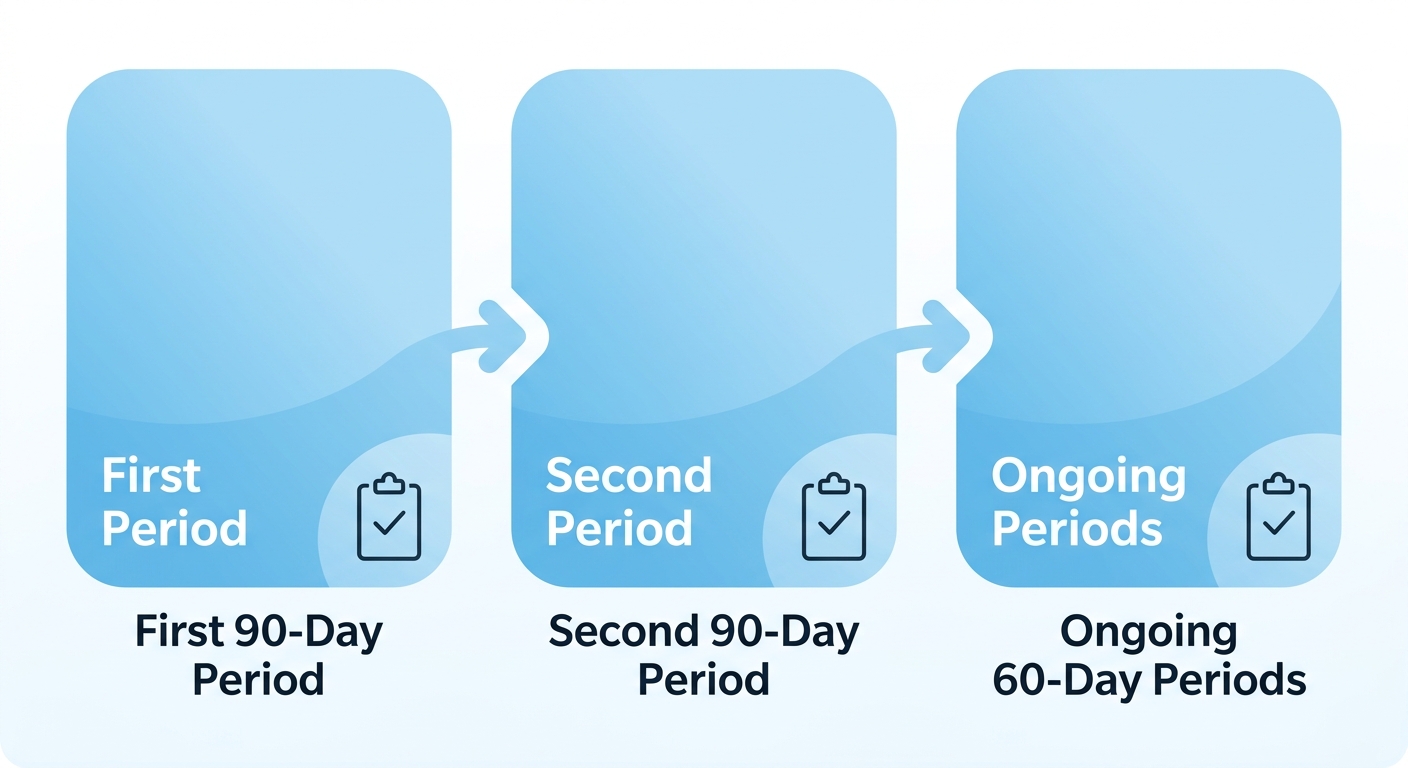
Once two physicians certify that a loved one’s terminal illness life expectancy is six months or less if the disease runs its normal course, Medicare’s hospice coverage begins. As our family guide explains, this coverage is structured into a series of benefit periods that ensure continuous comfort-focused support while regularly confirming continued eligibility. This framework replaces the uncertainty of acute-care coverage with predictable intervals of hospice care.
- First 90-day benefit period
- Second 90-day benefit period
- Unlimited 60-day benefit periods thereafter
Because the subsequent 60-day periods are unlimited, families can rest assured that coverage won’t run out as long as the patient continues to meet the six-month criteria. These Medicare hospice benefit periods are the backbone of the coverage: the patient is monitored closely, and before each new period starts, the hospice medical director or hospice physician must recertify that the patient still meets hospice eligibility criteria — a prognosis of six months or less if the terminal illness follows its normal path. Often, this recertification is completed in coordination with the patient’s attending physician, ensuring that the care plan remains personalized and responsive. The recertification process is designed to be a supportive checkpoint rather than a hurdle; our team works with families to prepare documentation and reassure everyone that the focus stays on comfort. Throughout all these intervals, the focus stays on comfort, symptom management, and emotional and spiritual support, not on curative treatment.
A crucial patient right to remember is that electing hospice does not lock anyone in. At any time, a patient can revoke or discontinue hospice services and return to standard Medicare coverage. Patients may discontinue hospice services at any time; hospice care focuses on comfort rather than cure. This election can be made at any time, whether the family decides to pursue new treatment options or simply needs a different level of care. As always, please consult with a healthcare professional for personalized medical advice.
At Cherish Hospice, we believe that we cannot change the outcome, but we can affect the journey. In every benefit period, care always matters, and our team is dedicated to managing pain and symptoms while honoring your loved one’s wishes. We treat your family like our own, guiding you through each recertification step with compassion, so you never feel alone in navigating Medicare’s requirements.
Next, let’s look at the care your family can expect during these Medicare hospice benefit periods.
The Role of Curative Treatment and the Bridge Program
When a loved one is diagnosed with a serious illness, families in Springfield, Ohio, and across our service areas often seek clarity about terminal illness life expectancy and what comes next. We understand that this is a deeply personal journey, and we are here to walk alongside you. As our team at Cherish Hospice knows, curative treatment and comfort-focused hospice care represent two different paths, and the transition between them is a decision each family makes in its own time. Our mission is to provide support every step of the way, ensuring that care always matters, no matter the stage of illness.
For those who may no longer benefit from aggressive treatments, hospice becomes an option when the goal shifts from curing the disease to maximizing comfort and quality of life. Under Medicare, the hospice eligibility criteria 6 months or less requires two physicians to certify that a patient’s life expectancy is six months or less if the disease follows its normal course. Many patients and families, however, are not yet at that point but still need skilled support to manage symptoms and explore restorative options. That is where our Bridge Program steps in.
The structure of Medicare hospice benefit periods—two 90-day benefit periods followed by unlimited 60-day periods, each requiring physician recertification—ensures ongoing evaluation of a patient’s condition. We designed the Bridge Program precisely for individuals who show signs of decline but don’t yet qualify for these benefit periods. Through the Bridge Program, our nurses monitor changes, provide education on advance directives, and coordinate care, helping you and your family navigate the period before a formal hospice admission. We cannot change the outcome, but we can affect the journey for you and your loved ones. Our 24/7 response team is ready to provide support and answer questions whenever you need us.
It is important to know that patients may discontinue hospice services at any time to pursue other treatments; hospice care focuses on comfort rather than cure. Every situation is unique, and we encourage you to consult with a healthcare professional for personalized medical advice. At Cherish Hospice, we treat your family like our own, and we are honored to support you with compassion, dignity, and the practical resources you need.
Embracing Compassionate Hospice Care with Confidence
When a loved one faces a serious illness or receives a life-changing diagnosis, the world can feel overwhelming. In these moments, care always matters. At Cherish Hospice, our team holds this belief close: "We cannot change the outcome, but we can affect the journey."
When a doctor has given a terminal illness life expectancy of six months or less, it’s natural to feel uncertain about what comes next. Hospice care focuses on comfort, dignity, and quality of life rather than cure. This guide will explain hospice care eligibility, when to begin, and how our interdisciplinary team—nurses, aides, social workers, chaplains, and volunteers—provides support that wraps around your entire family.
We treat your family like our own, and we’re here to help you take that first step. Let’s walk through what hospice care includes and how to recognize when the time is right to begin.