
Hospice Care Cost per Day in Ohio: 2026 Medicare Rates

Table of Contents
- Hospice Care Cost Per Day: A Guide for Ohio and Indiana Families
- How Hospice Care Is Financed: Medicare, Medicaid, and Insurance Coverage
- Medicare Reimbursement Rates and Daily Routine Home Care Costs
- Managing Out-of-Pocket Expenses: Room and Board, Residential vs. Home Care
- Alternative Funding Options: Veteran Benefits, Bridge Programs, and Non-Medical Support
- Frequently Asked Questions About Daily Hospice Care Costs
- Making an Informed Decision About Hospice Care Costs
Hospice Care Cost Per Day: A Guide for Ohio and Indiana Families
When a family member is diagnosed with a terminal illness, the hospice care cost per day often becomes an immediate concern. We want you to know that for families in Ohio and Indiana, Medicare’s hospice benefit typically covers the full cost of routine home care, including nursing, medical equipment, medications, and supplies. This means that most of our patients pay little to nothing out-of-pocket for their daily hospice services. Understanding this coverage is the first step to finding peace of mind during a challenging time.
Many families worry about the hospice care cost per day, only to find that Medicare and most private insurers cover the expense. The Medicare hospice reimbursement rates set a daily payment for routine home care, which includes all nursing, medical equipment, and medications. This routine home care daily rate is the foundation of coverage for our hospice and palliative care services. Because each patient’s insurance and needs are unique, we do not publish a single daily price. We invite you to contact us for a personal review of your coverage.
We encourage you to contact us for a personal discussion of your coverage. Please consult with a healthcare professional for personalized medical advice. Results may vary based on individual patient conditions. Patients may discontinue hospice services at any time; hospice care focuses on comfort rather than cure. Any protected health information you share will be handled in accordance with HIPAA privacy laws.
How Hospice Care Is Financed: Medicare, Medicaid, and Insurance Coverage
Understanding how hospice care is paid for can bring peace of mind. While you may have heard questions about the hospice care cost per day, the reality is that most families have little to no out-of-pocket expense because insurance, Medicare, or Medicaid covers nearly all services. At Cherish Hospice, we believe care always matters, and we help families navigate every financing option so you can focus on comfort and time together.
To give you a clear picture, the table below summarizes the most common payment sources.
| Payment Source | Coverage Details | Typical Out-of-Pocket Costs | Eligibility |
|---|---|---|---|
| Medicare Hospice Benefit | Covers all services related to terminal illness; no daily copay for routine home care | None for routine home care; small copays for inpatient respite or drugs | Medicare Part A eligible; prognosis ≤6 months |
| Medicaid (Ohio & Indiana) | Mirrors Medicare; state-specific rules may add services | Minimal; room & board in facilities may require contribution | Financially qualifying individuals; prognosis ≤6 months |
| Private Health Insurance | Varies by plan; often requires prior authorization | Deductibles, coinsurance, and daily copay possible | Policy-dependent; verify hospice benefit |
| Veterans Affairs (VA) | Hospice benefit for veterans; often at no cost | None for eligible veterans; may cover additional support services | Honorably discharged veterans; VA-enrolled |
| Out-of-Pocket / Self-Pay | Full daily costs paid by family | Full daily rate paid by family; contact Cherish Hospice for information | No insurance or desire to self-fund |
The table illustrates that most paths to hospice care involve little financial burden — particularly for those with Medicare, Medicaid, or VA benefits. Cherish Hospice accepts all of these payment sources, and our dedicated team verifies benefits so you understand exactly what is covered before care begins. This upfront clarity is part of our promise that we treat your family like our own.
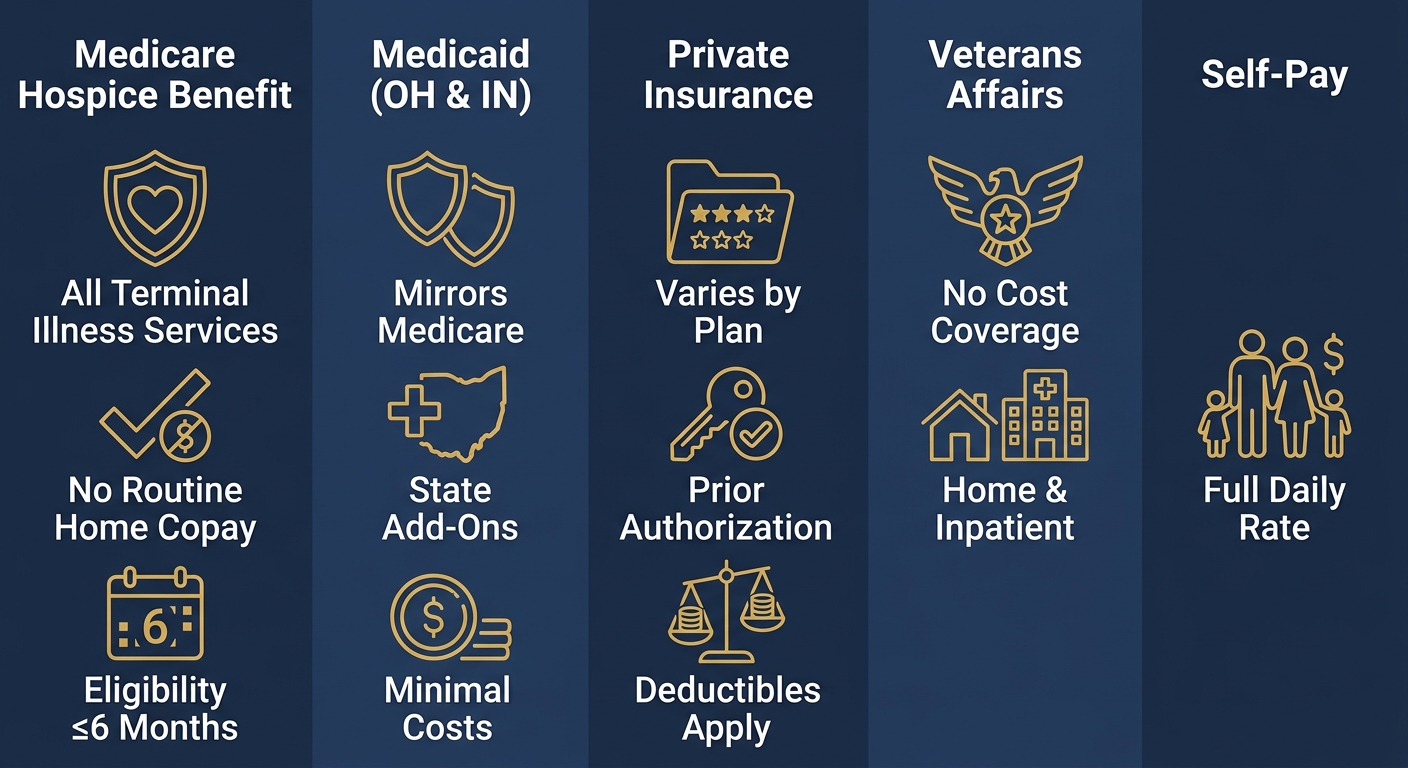
The Medicare Hospice Benefit, governed by the Centers for Medicare & Medicaid Services (CMS), is the foundation of coverage for most patients. It includes all services related to the terminal illness — from skilled nursing and pain management to medical equipment and grief counseling — with no copay for routine home care. While medicare hospice reimbursement rates and the routine home care daily rate are established centrally, families typically pay nothing for the core services delivered at home. Small copays apply only in limited situations, such as inpatient respite care or medications, and our team can walk you through those details.
Medicaid coverage in Ohio and Indiana mirrors the Medicare structure and may include additional state-specific supports. For residents of Ohio, Cherish Hospice provides comprehensive hospice and comfort care in Ohio, and Medicaid covers these services with minimal out-of-pocket costs. Eligibility requires a prognosis of six months or less, and we assist families in confirming that all requirements are met.
Private health insurance plans vary widely, often requiring prior authorization. Depending on the policy, you may encounter deductibles, coinsurance, or a daily copay. Our staff can review your plan and give you a straightforward summary so there are no surprises. For honorably discharged veterans enrolled in VA benefits, hospice care is typically provided at no cost and may include additional support services through our veteran program.
If you are considering self-pay, the full daily rate is covered directly by the family. We encourage you to contact us for a personalized, pressure-free conversation so you can explore all available options — we may identify coverage you didn’t realize you had.
Once you understand the financing options, the next step is to learn about eligibility and how to start services. We cannot change the outcome, but we can affect the journey. Reach out to Cherish Hospice anytime — our team is ready to verify your benefits and guide you with compassion.
Results may vary based on individual patient conditions. Please consult with a healthcare professional for personalized medical advice. Privacy Notice: protected health information (PHI) will be handled in accordance with HIPAA. Patients may discontinue hospice services at any time; hospice care focuses on comfort rather than cure.
Medicare Reimbursement Rates and Daily Routine Home Care Costs
Understanding Medicare Hospice Benefit and Reimbursement Rates
Now, let’s look at the financial side of hospice care and how Medicare makes it accessible. Understanding the hospice care cost per day is essential for families evaluating end-of-life care options. Medicare covers hospice as a per-diem benefit, with providers receiving a fixed daily payment based on the level of care the patient requires. According to the Centers for Medicare and Medicaid Services official website, there are four levels of hospice care under Medicare: routine home care, continuous home care, inpatient respite care, and general inpatient care. Each level has its own Medicare hospice reimbursement rates, which are updated annually by the Centers for Medicare & Medicaid Services (CMS). These rates ensure that hospice providers can deliver comprehensive services without patients facing large out-of-pocket costs. For routine home care—the most common level—the daily rate covers in-home visits, medical equipment, and medications related to the terminal illness, and families typically pay nothing out of pocket. To qualify for the Medicare Hospice Benefit, a patient must have a terminal diagnosis with a life expectancy of six months or less and must choose comfort-focused care instead of curative treatment. At Cherish Hospice, we accept Medicare assignment and help you navigate your benefits, making the process as straightforward as possible. This financial clarity is crucial when making care decisions, and we’re here to support you every step of the way.
How Routine Home Care Daily Rates Are Calculated
When a patient elects hospice at home, Medicare pays a routine home care daily rate that covers a comprehensive bundle of services. This hospice care cost per day is designed to be all-inclusive, so families rarely face surprise bills. The routine home care daily rate—approximately $200 per day as of 2025—covers skilled nursing visits, home health aide support, medical equipment like hospital beds and oxygen, medications related to the terminal diagnosis, and necessary supplies. It also includes the interdisciplinary care coordination that Cherish Hospice provides, from social worker visits to spiritual counseling and bereavement support. Importantly, for routine home care, there is no copay for these covered services; the per-diem rate is fully paid by Medicare. Because Cherish Hospice bills Medicare directly, you won’t receive bills for these services, which helps keep the hospice care cost per day as low as possible for families.
Key takeaways about the routine home care daily rate:
- It includes all necessary medical equipment, supplies, and hospice team visits.
- Patients and families pay nothing for covered services when receiving routine home care.
- The rate is set by CMS and may be adjusted annually to reflect healthcare costs.
- Cherish Hospice’s care team coordinates everything so families can focus on quality time.
Understanding this daily hospice cost under Medicare can bring peace of mind. We believe that financial clarity is part of compassionate care, and we encourage you to ask questions about your coverage.
Comparing Costs Across Different Care Settings
While routine home care is the most common level, Medicare also covers three other care settings when a patient’s needs change. The table below outlines the approximate Medicare daily reimbursement rates for 2025 and the associated patient cost share.
| Level of Care | Description | Medicare Daily Reimbursement Rate (2025) | Patient Cost Share |
|---|---|---|---|
| Routine Home Care | In-home hospice visits, equipment, supplies | ~$200/day | None (routine daily rate fully covered) |
| Continuous Home Care | Short-term crisis care at home; at least 8 hrs/day | ~$1,000/day | None for hospice services; possible drug copay |
| Inpatient Respite Care | Patient stays in facility to give caregiver a break | ~$500/day | 5% of Medicare-approved amount for each respite day (approx $25/day) |
| General Inpatient Care | Symptom management requiring 24-hr facility stay | ~$1,050/day | None for hospice services; small drug copays may apply |
Rates are approximate and subject to annual adjustments by CMS. Consult with Cherish Hospice for current details.
At Cherish Hospice, we serve families in Springfield, Ohio, Canton, Ohio, and Warsaw, Indiana, and we treat your family like our own. We guide you through every step of your hospice benefit so you can focus on what truly matters. Care always matters, and we cannot change the outcome, but we can affect the journey. Understanding the costs is just one part of the journey. Next, we’ll explore the comprehensive support Cherish Hospice provides to you and your family. Disclaimer: Results may vary based on individual patient conditions. Please consult with a healthcare professional for personalized medical advice.
Managing Out-of-Pocket Expenses: Room and Board, Residential vs. Home Care
Understanding hospice care cost per day is essential for families planning end-of-life care, as expenses can vary significantly depending on where services are received. We understand that managing costs is important to your family, and navigating these financial considerations with clarity is a key part of creating a care plan that honors both comfort and peace of mind.
Room and Board Expenses in Residential Hospice Facilities
When care is provided in a residential setting such as an assisted living facility or nursing home, families often encounter a cost structure that separates clinical services from housing expenses. While Medicare Part A covers hospice services delivered in these locations, the Centers for Medicare & Medicaid Services confirms that the room and board component remains the responsibility of the patient or family unless another payer, such as Medicaid, steps in.
The financial impact can be significant. In an assisted living facility, room and board may cost $3,000 to $6,000 per month, translating to roughly $100 to $200 per day. Nursing home room and board can be even higher, with private-pay rates generally ranging from $200 to $300 daily. Inpatient hospice facility stays are typically reserved for acute symptom crises and are covered by Medicare during those short-term episodes, but longer-term residential placement is not covered by the hospice benefit. These daily hospice care rates reflect housing and personal support not included in clinical hospice packages.
Medicaid can cover nursing home room and board for eligible residents, and it is always worth evaluating this possibility when care needs intensify. Because the daily costs accumulate quickly, understanding how the per-day expenses break down helps families make informed decisions about the right care environment.
Why Home-Based Hospice Care Is More Affordable
One of the most compelling financial advantages of choosing home-based care is the straightforward cost structure. Home hospice eliminates room-and-board charges entirely, so families face no housing fees for the care setting. Instead, Cherish Hospice focuses on delivering expert pain management, skilled nursing, aide visits, medications, and equipment—all covered by the Medicare hospice benefit. Our internal services guidance confirms this comprehensive coverage reduces the daily rate for home care to a minimal burden: typically only small copays for certain medications, often $0 to $20 daily.
The comparison table below illustrates how the routine home care daily rate aligns with true affordability. Because room and board are built into facility-based care, the per-day expenses there are substantially higher. We cannot change the outcome, but we can affect the journey, and keeping care at home allows families to direct their resources toward comfort, memory-making, and meaningful moments together rather than housing overhead.
The table below compares typical daily out-of-pocket costs across care settings.
| Care Setting | Daily Cost to Patient | What’s Included | What’s Not Included |
|---|---|---|---|
| Home Hospice (routine care) | $0–$20/day (copays for certain drugs only) | Nursing, aide visits, equipment, medications | Room & board, 24-hr caregiver |
| Assisted Living Facility Hospice | Room & board $3,000–$6,000/month (~$100–$200/day) | Hospice team visits, supplies; facility provides room/board | Room & board usually private-pay |
| Nursing Home Hospice | Room & board may be covered by Medicaid; otherwise ~$200–$300/day | 24-hr nursing, aide care, hospice visits | Private room upgrade, some personal items |
| Inpatient Hospice Facility | Typically covered for symptom crisis; otherwise ~$500-$1,000/day | Facility stay, nursing, symptom management | Longer-term residential placement not covered |
These figures reflect the real differences families encounter based on care location. Home hospice stands out as the most cost-effective path, with only minimal copays and no daily housing fee, while facility-based care layers significant room-and-board expenses onto the family’s financial responsibility. The difference can reach hundreds of dollars per day, which over weeks or months places immense strain on savings and household budgets. We treat your family like our own, and that means being transparent about how Medicare hospice reimbursement rates cover clinical care while leaving room and board as an uncovered expense that must be privately managed.
Strategies to Minimize Out-of-Pocket Costs
Taking proactive financial steps can substantially reduce the burden of hospice-related expenses. Practical strategies underscore that care always matters, and careful planning can ease the stress that families experience during this sensitive time.
- Evaluate Medicaid eligibility early: If the patient meets financial and clinical criteria, Medicaid can cover nursing home room and board and other uncovered costs.
- Utilize the Medicare respite care benefit: This benefit provides up to five days of inpatient care to give caregivers a break. One effective strategy is to use the Medicare respite care benefit, which provides up to five days of inpatient care to give caregivers a break—learn more about respite care for caregivers.
- Explore community assistance programs: Local nonprofits, faith-based organizations, and Veterans Affairs benefits often offer grants or subsidies that offset daily expenses not covered by Medicare.
- Negotiate with facilities: Some assisted living and nursing home communities adjust room-and-board charges or offer short-term charity care when families ask about available support.
- Clarify exactly what is covered: Regularly review the plan of care with our team so you understand which supplies, medications, and equipment fall under the hospice benefit, avoiding unexpected private-pay charges.
Cherish Hospice’s 24/7 dedicated response team and individualized care can help your family navigate these decisions without adding financial burden. For more ways to reduce costs, please speak with our care coordinators or review your insurance plan’s long-term care provisions. Results may vary based on individual patient conditions; consult with a healthcare professional for personalized medical advice.
We believe informed families make the best decisions, and we accompany you through every aspect of this journey with honesty, compassion, and practical support.
Alternative Funding Options: Veteran Benefits, Bridge Programs, and Non-Medical Support
Even with insurance, the looming hospice care cost per day can stir anxiety. At Cherish Hospice, we believe care always matters, and a range of alternative funding sources—from veteran benefits to bridge programs and community support—can help relieve financial pressure so you can focus on what truly counts.
| Program | Eligibility | Benefits | How to Access |
|---|---|---|---|
| VA Hospice Benefit | Honorably discharged veterans enrolled in VA care | Full hospice coverage, often at no cost; includes home & inpatient care | VA Medical Center or community provider; VA referral |
| Cherish Hospice Bridge Program | Patients not yet qualifying for hospice or palliative care | Education, regular monitoring, nursing support; smooth transition when eligible | Contact Cherish Hospice directly for evaluation |
| Local Community Grants | Varies by organization; often income-based or diagnosis-specific | Grants to offset copays, medications, or respite care | Social worker or hospice team can help identify sources |
| Charitable Care Programs | Often provided by nonprofit hospices for uninsured/underinsured | Sliding-scale or no-cost hospice services | Inquire during hospice admission process |
For families eligible for Medicaid, additional coverage may be available. Visit the medicaid and CHIP official portal to learn more. Even with medicare hospice reimbursement rates and the routine home care daily rate, many households still face coverage gaps. Our Bridge Program, available through Cherish Hospice, supports patients who do not yet qualify for hospice or palliative care—providing education, regular monitoring, and nursing support until a smooth transition is possible.
We cannot change the outcome, but we can affect the journey. That’s why our team actively helps families identify local grants and charitable care options during the admission process. These resources can cover copays, medications, or respite care, allowing you to concentrate on comfort and connection. Please remember that patients may discontinue hospice services at any time; hospice care focuses on comfort rather than cure. Results may vary based on individual patient conditions, and we encourage you to consult with a healthcare professional for personalized medical advice. Cherish Hospice is here to walk with you every step of the way.
Frequently Asked Questions About Daily Hospice Care Costs
You may still have questions. Here are answers.
How much does hospice care cost per day? Many families ask about the hospice care cost per day. Daily expenses are typically covered by the Medicare Hospice Benefit, so patients usually pay little or nothing.
What services are included in the daily rate? Medicare hospice reimbursement rates cover pain management, skilled nursing, hospice aide support, medications for the terminal diagnosis, medical equipment, and bereavement counseling—all part of the daily benefit.
How can we get a personalized cost estimate? The routine home care daily rate is the most common level. We encourage you to start an end-of-life care conversation with us, where we can discuss your costs. Cherish Hospice treats your family like our own, and we are ready to help.
Results may vary based on individual patient conditions and insurance coverage.
Making an Informed Decision About Hospice Care Costs
With our full range of services in mind, making an informed decision about hospice care costs starts with understanding the true value behind these numbers. When the phrase hospice care cost per day comes up, we encourage families to look beyond the daily cost of hospice and consider what’s included. Our 24/7 response team, alternative therapies, and skilled nursing reflect our commitment that care always matters. By understanding Medicare hospice reimbursement rates and how the routine home care daily rate reduces out-of-pocket spending, you can plan confidently. When you compare providers, ask about included services, family support, and any uncovered costs; after all, comfort and quality of life matter most, and we treat your family like our own.