
Hospice Care at Home in Springfield: Essential Guide for Families

Table of Contents
- Compassionate Hospice Care at Home in Ohio and Indiana
- Understanding the Essentials of Home Hospice Care
- Palliative Care vs. Hospice Care at Home: A Guide for Ohio and Indiana Families
- How to Get Started with Home Hospice Care in Ohio and Indiana
- Advanced Considerations for End-of-Life Care at Home
- Frequently Asked Questions About Hospice Care at Home
- Moving Forward with Confidence: Supporting Your Family’s Journey Through Home Hospice Care
Compassionate Hospice Care at Home in Ohio and Indiana
When we discuss hospice care at home, we center everything around the truth that care always matters. At Cherish Hospice, we embrace a philosophy that We cannot change the outcome, but we can affect the journey. Our compassionate team brings personalized, home-based care to families in Ohio and Indiana, allowing your loved one to remain in the comfort and familiarity of home, surrounded by the people who mean the most.
We provide a 24/7 response team and individualized pain and symptom management as the cornerstones of our support. Beyond clinical care, our holistic approach includes complementary services such as pet therapy, aromatherapy, and volunteer programs that create moments of connection and joy. We treat your family like our own, ensuring that emotional, spiritual, and social needs are met by our interdisciplinary team of nurses, physicians, chaplains, and social workers.
Our services are available once hospice eligibility criteria are met and are distinct from palliative care, which can begin earlier in an illness. While results vary for each individual, our focus is always on comfort, dignity, and quality of life. Families have the right to discontinue services at any time.
Serving communities across Ohio and Indiana—including Springfield, Canton, and Warsaw—we bring comfort care directly to your home. Learning how to start is simple. After a no-cost in-home assessment, we develop a personalized care plan that honors your loved one’s wishes. Discover how to begin hospice and comfort care in Ohio with our straightforward initiation guide.
Understanding the Essentials of Home Hospice Care
One of the most common settings for hospice care is the patient’s own home, where comfort and dignity come first. When a loved one chooses hospice care at home, the focus shifts from curative treatments to maximizing quality of life in a familiar setting. Home hospice care brings an entire team of skilled professionals directly to the residence, so patients can be surrounded by the people and memories they treasure most.
Our interdisciplinary team works together to address the physical, emotional, and spiritual needs of each individual. Registered nurses, hospice aides, medical social workers, chaplains, and trained volunteers make regular visits, providing medical oversight, daily living assistance, and compassionate companionship. A dedicated 24/7 response team stands ready at any hour for urgent symptom control or hands-on support, giving families confidence that help is always available. We also integrate alternative therapies unique to Cherish Hospice—Cherish Touch hand and foot massage, Cherish Sounds soothing music, aromatherapy, and pet therapy—to offer comfort beyond medication. Our team provides hospice and comfort care in Ohio to families in Springfield, Canton, and the surrounding counties, bringing these comprehensive services right to the doorstep.
While many wonder about palliative care vs hospice, the key difference is that hospice focuses exclusively on end-of-life comfort for individuals with a terminal illness. To receive hospice care, a person must meet hospice eligibility criteria, which typically require a physician-certified prognosis of six months or less. Once enrolled, the care plan centers on expert pain and symptom management, spiritual and emotional support, and practical help with daily tasks. We treat your family like our own, extending that same care to loved ones through bereavement counseling and respite for family caregivers. Our team works to honor the whole person, using comfort measures that promote peace without hastening or postponing the natural course of life.
We understand that this journey is filled with deep emotions and uncertainty. Our commitment is that care always matters, and we walk alongside you with gentle, responsive support. We cannot change the outcome, but we can affect the journey—ensuring that every moment is wrapped in compassion. Patients may discontinue hospice services at any time, as hospice care focuses on comfort rather than cure. Results may vary based on individual patient conditions, so we encourage families to speak with our team or a healthcare professional for guidance tailored to their situation.
Understanding these essentials sets the stage for exploring who qualifies for hospice care at home.
Palliative Care vs. Hospice Care at Home: A Guide for Ohio and Indiana Families
Now that you understand the spirit of our care, let’s explore how hospice care at home compares to palliative care so you can choose the right path for your loved one.
Key Differences Between Palliative and Hospice Services
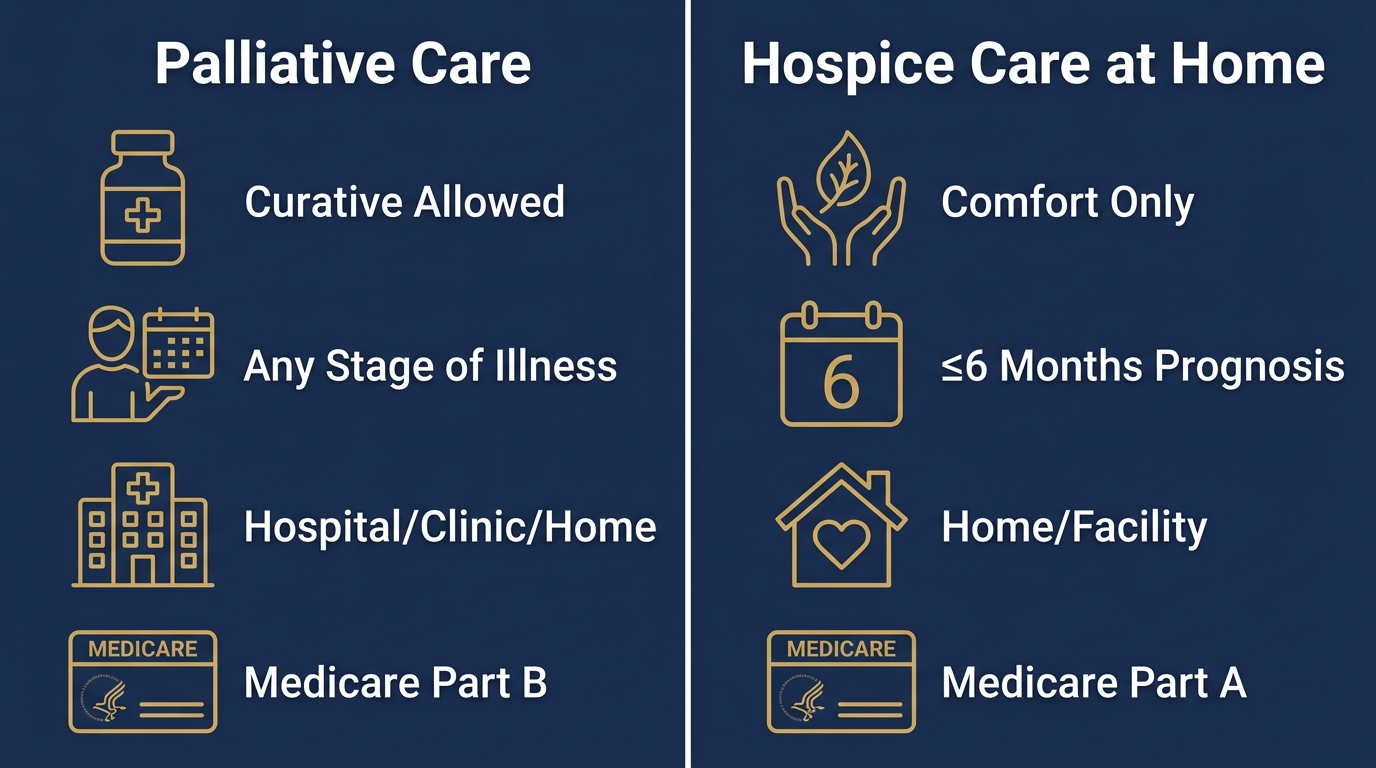
When weighing palliative care vs hospice, families in Ohio and Indiana often notice the core distinction revolves around treatment goals. According to Cherish Hospice, palliative care can be delivered alongside curative treatments at any stage of a serious illness, while hospice care at home is comfort-focused support for patients with a terminal prognosis of six months or less. Palliative care is not tied to prognosis and continues as long as symptoms need management, frequently under Medicare Part B. The table below summarizes the key differences:
| Feature | Palliative Care | Hospice Care at Home |
|---|---|---|
| Goal of Care | Relieve symptoms and improve quality of life alongside curative treatments | Comfort-focused care when curative treatment is no longer the goal |
| Eligibility | Any stage of a serious illness, regardless of prognosis | Terminal prognosis of six months or less if the disease runs its normal course |
| Curative Treatments | Can be continued | Not provided; care focuses on comfort and quality of life |
| Typical Setting | Hospital, clinic, or home | Patient’s home, nursing facility, or hospice unit |
| Medicare Coverage | Part B covers palliative services as part of regular medical care | Medicare Part A covers all hospice-related services, including medications and equipment |
| Duration of Care | Ongoing, as long as symptoms need management | Recertified every 90 days; may extend beyond six months if condition persists |
This comparison makes clear that the decision hinges on the treatment goal and prognosis—palliative care supports quality of life during treatment, while hospice care at home focuses exclusively on comfort when a cure is no longer possible. At Cherish Hospice, we help families navigate these choices with compassion, and for those not yet meeting hospice criteria, our Bridge Program provides monitoring and support, ensuring care always matters during uncertain times.
Understanding eligibility helps you take the next step.
Medicare Eligibility Standards for Home Hospice Patients
For Ohio and Indiana families, the Medicare hospice eligibility criteria are straightforward but essential to understand. According to Medicare, your loved one must meet three requirements: a hospice physician and the patient’s regular doctor must certify a terminal illness with a life expectancy of six months or less; the patient or legal representative must elect the hospice benefit and agree to forgo curative treatments; and care must be provided by a Medicare-approved hospice provider like Cherish Hospice. We often guide families through this process, and our Bridge Program supports those who do not yet meet the criteria but still need comfort-focused nursing and support.
Understanding Payment and Coverage Options
Medicare Part A covers virtually all hospice-related expenses, including nursing visits, medications for symptom management, medical equipment, and short-term respite care in Dayton, Ohio—giving family caregivers a much-needed break with only minimal copays. For families with Medicaid or private insurance, coverage details vary, but many plans include home-based hospice benefits. At Cherish Hospice, we cannot change the outcome, but we can affect the journey by helping you navigate these financial questions so that you can focus on what truly matters. We treat your family like our own and encourage you to reach out for a free eligibility assessment—our 24/7 response team is ready to discuss individualized pain management and all the ways we deliver compassionate hospice care at home in Ohio and Indiana.
In the next section, we’ll detail the specific Comfort Care services available through our dedicated teams.
How to Get Started with Home Hospice Care in Ohio and Indiana
Now that you understand what home hospice care entails, the next step is getting started with hospice care at home in Ohio and Indiana. At Cherish Hospice, we guide families through every practical and emotional aspect of beginning home hospice care, from arranging essential equipment to understanding insurance coverage and transitioning from other care settings.
Essential Equipment and Supplies for Home Hospice Care
Starting home hospice care brings the reassurance that necessary medical equipment and supplies are provided and set up at no cost to your family. When we begin hospice care at home, our team coordinates the delivery and setup of a hospital bed, an oxygen concentrator if needed, a walker or wheelchair for mobility, a commode for convenience, and an over-bed table for meals and personal items. All of this is covered under the Medicare hospice benefit, so there is no out-of-pocket expense for you.
We handle everything from scheduling the delivery to showing you how to use each item safely. If any equipment needs adjustment or replacement, our 24/7 response team is just a phone call away. Having the right equipment in place from the start reduces anxiety and allows families to focus on spending quality time together. We also supply consumable items like incontinence products and skin care essentials to maintain dignity and comfort. We treat your family like our own, making sure every detail is taken care of so you can be fully present.
Insurance Coverage and 24-Hour Nursing at Home
Understanding how insurance covers home hospice services can ease financial concerns. Medicare, Medicaid, and private insurance each have different coverage details, but most families find that hospice care is well supported. It helps to know what to expect so that you can plan with confidence.
Medicare Part A covers all hospice services including skilled nursing, medical equipment, medications for symptom management, and bereavement support, with no deductible. However, it’s important to know that 24-hour private duty nursing is not typically covered; Medicare only provides continuous nursing care during periods of crisis when symptoms cannot be managed at a lower level. For official details about what Medicare covers, check the Medicare hospice coverage page. Ohio and Indiana Medicaid programs often mirror this structure and may cover additional personal care services. Private insurance plans vary, and some long-term care policies may include limited 24-hour in-home nursing after a hospital stay.
Where insurance stops, Cherish Hospice steps in. Our 24/7 dedicated response team fills critical gaps by providing hands-on clinical guidance and support whenever families need it. While we do not offer continuous in-home nursing, our team is always ready to respond to questions, manage sudden symptoms, and bring comfort at any hour. Care always matters, and we ensure that expert help is never far away.
The table below summarizes what different coverage types typically include.
| Coverage Type | Hospice Care at Home | Palliative Care | 24-Hour Nursing at Home |
|---|---|---|---|
| Medicare | Part A covers all hospice services with no deductible; includes nursing, equipment, medications, and bereavement support | Part B covers doctor visits and medically necessary services; may require copays for certain palliative treatments | Continuous nursing care covered only during periods of crisis; 24-hour private nursing not typically covered |
| Medicaid | State-specific programs often mirror Medicare; may cover additional personal care | Varies by state; may include palliative services through managed care plans | Similar to Medicare; 24-hour private duty is generally not covered |
| Private Insurance | Most plans cover hospice care; details and copays vary | Often covers palliative consultations and symptom management | Some long-term care policies may include 24-hour in-home nursing after a hospital stay |
Transitioning from Palliative to Hospice Care at Home
Transitioning from palliative care to hospice care at home can feel overwhelming, but it’s a natural step when curative treatments are no longer the priority. The first action is to communicate openly with your current palliative care provider and request a hospice eligibility reassessment. This process typically includes a physician’s certification that life expectancy is six months or less if the illness follows its normal course, which helps determine whether you meet the hospice eligibility criteria.
Understanding the palliative care vs hospice difference is key. Palliative care aims to relieve symptoms at any stage of a serious illness, while hospice care is specifically for those with a terminal prognosis who seek comfort-focused support. At Cherish Hospice, our Bridge Program supports individuals who do not yet fully qualify for hospice care but need extra help—providing monitoring, education, and compassionate connection until the right time. When you are ready, we encourage you to contact Cherish Hospice to schedule a no-obligation consultation. A nurse will evaluate your loved one’s situation, explain next steps, and help smooth the change with continuity of care.
We cannot change the outcome, but we can affect the journey. Please remember that results may vary based on individual patient conditions. We recommend consulting with a healthcare professional for personalized medical advice. Once you have the logistics and coverage in place, you can focus on managing symptoms and ensuring comfort at home.
When considering in hospice care at home, families often face shifts from routine comfort to more complex challenges—but care always matters most when needs are greatest. We cannot change the outcome, but we can affect the journey by providing expert support that evolves with your family’s needs.
Managing Complex Symptoms at Home
While basic comfort measures maintain baseline comfort, advanced symptom management addresses acute episodes—terminal agitation, respiratory distress, or severe pain—that can overwhelm family caregivers. That’s why advanced care in hospice care at home relies on round-the-clock support from our 24/7 response team. With rapid coordination among our medical director, nurses, and aides, we bring relief quickly, ensuring comfort and dignity remain priorities even during the most challenging moments.
The Role of Alternative Therapies
Beyond medical management, we incorporate gentle alternative therapies into the home to soothe both body and spirit. Our Cherish Touch hand-foot massage, Cherish Sounds calming music, and aromatherapy can reduce anxiety and promote relaxation. These simple additions often allow patients to feel more at peace and families to share quieter moments. The aim is to create a comforting space with familiar sensations. Because each person responds differently, results may vary based on individual patient conditions, but many find these therapies add a layer of comfort medication cannot provide.
Emotional Support for Caregivers
The emotional weight of caregiving is immense. Our grief counseling starts before loss, and spiritual support is tailored to your family’s traditions. We treat your family like our own. The palliative care vs hospice distinction is important: hospice focuses on comfort at home when cure is no longer expected. For those who don’t yet meet hospice eligibility criteria, our Bridge Program offers education and monitoring. Patients may discontinue hospice at any time; we focus on comfort, never hastening or postponing death.
And while our support during the journey is comprehensive, we also extend that care to your family afterward, as we’ll explore next.
Frequently Asked Questions About Hospice Care at Home
You may still have questions. Here are the most common answers.
What is hospice care at home? Hospice care at home in Springfield, Ohio is a Medicare-covered program delivering skilled nursing, pain management, and comfort care at home. We cannot change the outcome, but we can affect the journey.
What are the hospice eligibility criteria? A doctor certifies a terminal illness with a six-month prognosis, and the patient opts for comfort over curative treatment. These hospice eligibility criteria ensure our in-home hospice care is appropriate.
How does palliative care vs hospice differ? Palliative care vs hospice: palliative care can begin at any stage of serious illness alongside curative therapy, while hospice is exclusively for end-of-life comfort. We believe care always matters at every stage.
We hope this helps you take the next step. Contact us to learn more.
Results may vary based on individual patient conditions. Please consult a healthcare professional for personalized medical advice.
Moving Forward with Confidence: Supporting Your Family’s Journey Through Home Hospice Care
Choosing hospice care at home in Springfield, OH, is a deeply personal decision, and we’re here to support your family through it. Our 24/7 response team, individualized pain management, and alternative therapies like Cherish Touch and pet therapy provide comfort. Through our Bridge Program, we guide families exploring hospice eligibility criteria, and our veteran and volunteer programs ensure no one feels alone. Bereavement and grief counseling continue for at least a year, because care always matters. We cannot change the outcome, but we can affect the journey. We treat your family like our own.